Tuesday, March 21, 2006

"How many weapons did Santji have, what kind of weapons did he have?"

Waheguru Ji Ka Khalsa Waheguru Ji Ki Fateh

Soora So Pehichania

After I met Sant Bhindranwale, my son asked me, "How many weapons did Santji have, what kind of weapons did he have?"

I said that the weapons of Sant Bhindranwale, nobody has weapons like those in all the world. The way the devotion and commitment to Sant Bhindranwale came, that was some kind of mystery, some kind of mysic inspiration.

There used to be baptism ceremonies at least twice a month, later more often as Santji became more popular. Sometimes thousands of people would get baptized in a single day. Santji's impact was so powerful, people would rush forward not only to get baptized but to join him, to give up their homes and their families to stay with him.

He was great lover of humanity, sensitive to the down-trodden. And he was a very disciplined man, spending hours and hours with the scriptures even in his busy schedule. He expected the same devotion from everybody who joined him.

We follow in the footsteps of Baba Deep Singh, he would say, heads in our palms. Such an inspiration he gave, will never be forgotten. Anybody who saw him was touched by him.

Waheguru Ji Ka Khalsa Waheguru Ji Ki Fateh

"If you stop trying, you'll become my brother quicker"

Waheguru Ji Ka Khalsa Waheguru Ji Ki Fateh

The world sings Sant Bhindranwale's eternal story

The first thing I noticed about Bhindranwale was that he made everybody feel welcome.

Nobody was an outsider with him, no matter what their appearance, clean-shaven or bearded. He was very human, very soft. He was firm on his views, of course, but he had a sense of humor, too.

He asked me, "When are you going to become my brother [when are you going to become orthodox, grow a beard]?"

I answered, "Well, I'll try."

But he laughed and said, "If you just stop trying, you'll become my brother quicker. From the facial aspect, I mean!"

What he meant was that if I just let nature take its course, if I didn't shave, I would look like a Sikh more quickly.

This was the way he would gently remind people to live as Sikhs. He was clear in his example, but he didn't put pressure on me or anything. Everyone would feel comfortable in his presence.

Waheguru Ji Ka Khalsa Waheguru Ji Ki Fateh

Bleeding Punjab

Waheguru Ji Ka Khalsa Waheguru Ji Ki Fateh
Immortal Productions - Punjab
Atrocities perpertrated on the Sikhs:
Dear Rastrapati ji, We are giving below the methods of torture, humiliation and atrocities used by your stateagainst the Sikhs. These have been mentioned by the humanitarian organizations andindividuals who hold prestige in their respective fields. These organizations and individualsare not seen directly or emotionally connected with our movement. They have been forcedto write about the extreme violations of human rights of our people. We wish you to knowand witness the continuous repression and atrocities perpetrated against the Sikhs by yourarmy, paramilitary forces and the police. We are not presenting all this to you to win yoursympathy, nor do we wish you repent by taking pity on us. In fact by situating you in thispicture we want to have the verdict of the people of the world over the extent you haveviolated the UNO's Declaration on Human Rights, the Geneva Convention, and manyother international treaties. We are mentioning below the violations and atrocities:
  • To interrogate the Sikhs, a round log of wood is placed on their legs, and afterputting heavy weight on the log it is rotated on the legs.
  • Chilli powder is sprinkled in the eyes and sex organs of the Sikhs. Sikhs are hung upside down from the ceilings till they became unconscious.
  • The body joints are battered.
  • Electric shocks are administered to the genitals making most of the youth impotent.
  • Sikh women, during interrogation, are hurt in their sex organs. Filthy abuse is howered on them.
  • Violence is inflicted on the parents in presence of their sons and daughters andvice-versa.
  • Brothers are forced to beat sisters and vice versa. Violence is inflicted on adult girlsafter stripping them naked and their sex organs are damaged. They are sexually assaulted, pregnancies are terminated of the expectant females.
  • Crotchets are pulled apart.
  • The victims of inhuman violence are made to sit naked in winter, and under the sunin summer, kept sleepless for days in solitary cells.
  • Sikhs are subjected to severe beatings and filthy abuse in the presence of their village folks.
  • Dead bodies of Sikhs killed in fake encounters are not handed over to their parents to conceal marks of excessive violence.
  • The state manipulates tailored post mortem reports from the doctors, and burns the dead bodies of the Sikhs after falsely declaring them unclaimed.
  • All sorts of excesses are made on the parents of underground Sikh youths.
  • Indiscriminant atrocities are committed on the parents of the underground youth ofthe area where some militant action takes place.
  • Atrocities are committed without caring for one's age, health, life or death. If someone luckily survives such brutal excesses, it is well and good But if one dies while under "interrogation", then such a dead body is taken out, pierced with somebullets, and a news item is sent that a dreaded terrorist has been shot dead in an encounter.
  • Houses of underground Sikh youths are demolished, their belongings are looted,crops destroyed, their tube well motors are taken away, and they are prevented from sowing crops.
  • Even animals of the families of underground Sikh youth are subjected to police anger. After summoning the families to the police station, villagers are told not to take care of the animals of the families of the underground youth. Generally the animals starve to death.
  • False cases are registered against innocent sikh youths, later they are let off taking fat bribes.
  • Reporters giving true reports are arrested, an undeclared censorship is imposed on them to stop them from exposing police atrocities. Peaceful protests by the Human rights organizations are prohibited.
  • Press is used to launch vicious and false propaganda against the Sikhs.
  • Hardened criminals are inducted into Sikh movement to help in arresting the Sikh revolutionaries and sabotage the movement. Such criminals are inducted to tarnish the fair name of the Sikh revolutionaries are now called the "Black Cats" in the Punjab. Under SSP Izhar Alam, such criminal gangs were named the "Alam Sena."Besides, such police sponsored bands of criminals also operated under the name ofPanthic Tiger Force and "Red Brigade." The director general of the police himselfadmitted about the "Black Cats" bands. In his interview to the India Today on Sept.15, 188, KPS Gill had announced without an iota of shame that the security forces inPunjab cannot do anything without the help of secret bands (Black Cats).
  • Thousands of innocent pilgrims, children, females, aged people, who got encircled inthe Golden Temple during operation Bluestar were made to die through starvationand thirst. The whole of Punjab was converted into a vast jail by clamping curfew onthe entire area. The army bulletin branded all Amritdhari Sikhs as terrorists.
  • Indian army desecrated the Gurdwaras and committed such atrocities on the Sikhsthat even the soul of Ahmed Shah Abdali might have felt ashamed of.
  • The targets of army guns were none else but religious persons, devotees, pilgrims,ladies, old people, children or some militants whom the indian government deemed as terrorists.
  • No neutral observer was allowed to take stock of the situation. The injured during the attack on the Golden Temple were subjected to extreme partiality. Whereas every assistance and facility was made available to the injuredarmy personnel, there was no such provision for the wounded belonging to the otherside. The number of prisoners taken was rather small. There is ample scope for doubtthat the Indian army had thought it better to eliminate the thousands of peopleseized in the Golden Temple instead of taking them prisoners or having to providethem with medical assistance. No need was felt to perform religious rites for the dead pilgrims and devotees.
  • Before consigning the dead bodies to flames, no effort was made to identify them. No relatives were informed.
  • No dead bodies were handed over to the next of kin. In such a situation only the dead or those wishing to be dead could be present at the last rites.
  • All dead bodies were placed in heaps and then consigned to flames. It was never insured that among the dead there could also be some Muslim devotees. To cremate is against the tenets of Islam.
  • No need was felt to give a list of the dead to the Red Cross or any otherInternational Agency.
  • Despite such atrocities, no commission was appointed to go into this dark episode.Even the Britishers, the foreign rulers, had cared to appoint the Hunter commissionto inquire into the Jallianwalla Massacre which was of a much less magnitude on theother hand. The Indian government, on the other hand, took all steps to hide theexcesses of the army.

Taken from the 1990 letter by Shaheeds Bhai Harjinder Singh Jinda and Bhai Sukhdev Singh Sukha to the President of India, R.Venkataraman, from jail.

Waheguru Ji Ka Khalsa Waheguru Ji Ki Fateh

Monday, March 20, 2006

Dehli; Punjab is asking about 1984 - Part 2

Waheguru Ji Ka Khalsa Waheguru Ji Ki Fateh
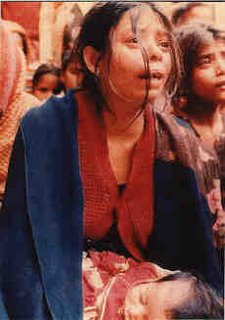
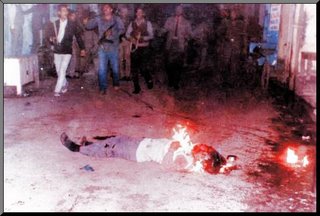
Pappi Kaur and her family had rushed out for safety when they saw the rioters closing in. But the police made them return home. Then she saw her father being dragged out of their home, tortured and burned to death by men who claimed to be avenging the killing of Indira Gandhi. She saw the murderers dilly-dally with her uncle, then burn him too. She was six years old. As they rebuild their lives in the neglected and almost forgotten colony for widows of the 1984 riots, Pappi, 25, cannot help feeling bitter about the administration that let them down twice
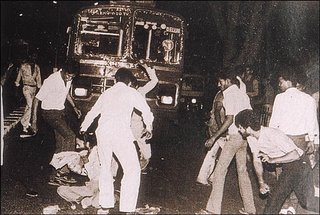
I was very young in 1984. But how can I forget the day on which all the men of my family were ruthlessly murdered? At the time, we were staying in Chilla village, near Trilokpuri in east Delhi. My father came back early from work, looking very tense, and told us about the riots in the city, that people were killing Sikhs all over Delhi. But it was not as if he, or the neighbourhood, felt that everything around us would change in the next few hours.
We went up to the terrace and saw that our neighbourhood gurdwara had been set on fire. That was when we felt the first jolt of panic. The rioting was no longer ‘in the city’. It was coming nearer home. We decided to go to the gurdwara to protect it as best as we could. There was my father, his younger brother, my mother and grandmother and we, the children. On our way, we saw hordes of murderous-looking people and fierce fighting. The police stopped us and told us to return home.
We did, but that was a mistake. At home, we were sitting ducks. A mob broke down the wooden door of our house, dragged out all the menfolk one by one, beat them up and then set them on fire.
My father was first. We couldn’t see what happened, because they took him out of the house. Then it was his younger brother. He had shorn his hair. At first, they were willing to let him go. But then they changed their mind, dragged him out again, beat him up and set him on fire as well. The attackers did not even spare my poor old grandmother. They broke her arm and abused her. They told her that she should leave the neighbourhood immediately or they would kill all the children. I can still see their vicious faces. They were shouting, "Tune hamaari maa ko maara hai. Hum tujhe maarenge! You killed our mother (Indira Gandhi), we will kill you!" They put burning tyres around the necks of the Sikhs they were torturing before the slaughter, and shouted, "Dekho sardaar kaise naach rahe hain! Look how the Sikhs are dancing!"
My grandmother and mother ran away with the children. We hid in a wilderness, away from the residential colonies. For three days and nights, we stayed in hiding. On the fourth day, the army came in and took over from the police. That was the first time we felt safe.
Later, we were informed that we would be resettled and awarded compensation. It is true that we were given a one-time compensation. Widows were given jobs, but not near their homes. Their places of work were scattered all over Delhi. And they have to raise their families on the pittance they make in these ‘Class IV’ jobs. There is an area here in Tilak Vihar called the Widows’ Colony. It’s only for the widows of the 1984 riots. That’s where we were shunted. There was no other attempt to reach out to us in any way. Not one leader, from any community or political party, ever comes this way.
Waheguru Ji Ka Khalsa Waheguru Ji Ki Fateh

Wednesday, March 15, 2006

Defenders of the Faith

Waheguru Ji Ka Khalsa Waheguru Ji Ki Fateh
“The army went into Darbar Sahib (Golden Temple Complex) not to eliminate a political figure or a political movement but to suppress the culture of a people, to attack their heart, to strike a blow at their spirit and self-confidence.”
(Joyce Pettigrew, The Sikhs of Punjab, London: Zed Publishers, 1995)


"The Akali Dal (the Sikh Organization) is in the hands of moderate and sensible leadership…but giving anyone a fair share of power is unthinkable politics of Mrs. Gandhi… Many Hindus in Punjab privately concede that there isn't much wrong with these (Sikh) demands. But every time the ball goes to the Congress Court, it is kicked out one way or another because Mrs. Gandhi considers it a good electoral calculation."
(Pran Chopra, Wall Street Journal, September 26, 1983)
"The whole of Punjab and especially the Golden Temple Complex, was turned into a murderous mouse trap from where people could neither escape nor could they seek succor of any kind…The way the dead bodies were disposed of adds to the suspicions regarding the number and nature of the casualties...The bodies of the victims of military operation in Punjab were unceremoniously destroyed (the report refers to Chapter II Article 17 of Geneva Convention of 1949) without any attempt to identify them and hand them over to their relatives…So even the courtesy and honor customarily shown to the dead soldiers of the enemy was not shown to our dead countrymen, since those killing them were our own soldiers. Because the government had decided to exterminate these victims physically they ceased to exist as persons deserving any honor of human dignity. We lack even the civility of the British imperialists, who after the Jalianwala blood bath instituted the Hunter Commission to make a thorough enquiry into the events. The government, after the operation, on the other hand, did every thing in its power to cover up the excesses of the army action…The most disturbing thing about the entire operation was that a whole mass of men, women, and children were ordered to be killed merely on the suspicion that some terrorists were operating from the Golden Temple and other Gurdwaras. There had been no judicial verdict of guilt against definite individuals who had been taking shelter in the Golden Temple."
(CKC Reddy, et. al., Army Action in Punjab: Prelude & Aftermath, New Delhi: Samata Era Publication, 1984, pp. 46-48)
"When the agitation began...it was led by reasonable men seeking a reasonable settlement of reasonable demands. And at least three times there were prospects of agreement...but each time Prime Minister Indira Gandhi sabotaged the agreements.”
(Kuldip Nayar, India Abroad Weekly, New York, June 22, 1984)
"The ugly situation prevailing in Punjab would not have taken place if the legitimate demands of the Sikh community had been conceded. In fact, there should have been no need for anyone to have agitated for these demands in the first place if events had moved on the principle of justice and fair play."
(Bharat Kumar Baweja, India Abroad Weekly, New York, June 29, 1984)
"There was a nonviolent Sikh protest movement, but it was eclipsed when the Prime Minister rebuffed its demands…Since Indian independence in 1947, Sikhs have pleaded for greater autonomy and for specific recognition of their religion in the Constitution."
(The New York Times, Editorial, June 8, 1984)
"Proclaiming the primacy of national union even over a religious shrine, Mrs. Gandhi ordered a bloody assault last June, and loosed the demons that apparently claimed her life."
(The New York Times, November 1, 1984)
"...over a thousand pilgrims including children and old people quite unconnected with the separatists, were locked into a courtyard and attacked with grenades and machine guns. Those left alive were then prevented from leaving the building, many wounded were left to bleed to death...some 3,000 dead, including many who were only unconscious, were piled high in trucks and removed."
(Amrit Wilson, New Statesman, November 16, 1984)
Waheguru Ji Ka Khalsa Waheguru Ji Ki Fateh

Tuesday, March 14, 2006

Dehli; Punjab is asking about 1984

Waheguru Ji Ka Khalsa Waheguru Ji Ki Fateh


Charanjeet Singh was four years old when rioters broke into their home and killed his parents. Hiding under the bed with his brother, sisters and grandmother, he saw his father and mother being beaten mercilessly and burned alive. Today, 19 years later, Charanjeet, 23, and his siblings continue to fight for a normal life in spite of the social, financial and emotional handicaps that life has dealt them

I was just four at the time. We had a large plot of land in Baljeet Nagar, a Sikh colony, and a comfortable house. There was a gurdwara some distance from our house. Most Sikhs in the area lived near it. My earliest memory is of an announcement over loudspeakers: there was trouble in town, those who wanted shelter should rush to the gurdwara. By the time we understood, it was too late to make it to the gurdwara. We were not close enough. The loudspeaker continued to blare out news that Sikhs were being killed. In a panic, my father bolted the door and shut all the windows. He pushed me and my siblings — my elder brother and sister and my infant sister — under the cot. He then tried to fit my mother and grandmother in there as well.

By this time, the rioters had reached our door. Some of them banged violently at the door. Some others, meanwhile, had climbed onto our roof. They broke into our house through the roof. I am not sure, but I think there were four or five of them. They unbolted the door and dragged my father out. We were frozen under the bed, unable to even scream. From where we were, we could see them thrashing him mercilessly, hitting him with stones, and as he lay there bleeding profusely, they poured kerosene on him and set him on fire. He didn’t stand a chance. He was burned alive. I can still see it all as if it had happened just a few hours ago. His blue clothes. The fire. The screaming. My younger sister, mercifully, was too young to know what was happening. But for the rest of us there was no respite. And nothing has changed.

I remember my mother starting to scream from her hiding place. She could not take it any more. The rioters, finished with my father, turned their attention to her. They pulled my mother out by her hair. They beat her and kicked her, and pulled out her hair. Then they set her on fire as well.

Even today, in spite of our best attempts, we have no idea what happened to my parents’ bodies. We do not know if they were cremated or buried.

The world has never been the same for me since. People I trusted, people I called ‘uncle’ or ‘aunt’, were either actively inciting the attackers or were silent spectators. Once our parents were dead, they ransacked our house and took everything we had. We waited under the bed till things went quiet. A long while later, we left the house, trying to stay out of sight, went to the gurdwara and hid there.

Eventually, my grandmother brought us here after many days in hiding. She never entirely recovered from the shock. Most of the money we got as compensation was spent on her treatment. She was our only surrogate parent, and we don’t know what we would have done without her. She finally passed away in 1998. As long as she was alive, we used to get a pension of Rs 1,000. When she died, even that stopped.

Now, it’s just the four of us. The three of us, actually. We got my elder sister married earlier this year. It was not easy to find a groom who would marry her without a dowry. Finally, we met my brother-in-law and he agreed to marry her, expecting nothing more than the ‘three clothes’ she wore.

The irony of the situation is that all prospective bridegrooms seem to think we have a lot of money. They say, "You got a compensation of Rs 3 lakh. Where is that? We want our wife’s share of that as dowry." They demand refrigerators and motorbikes. Even without a dowry, arranging a marriage is expensive business. We have taken loans of almost Rs 50,000. How are we ever going to pay it back? And there’s still our younger sister, who is now 19. We have to get her married too.

Then there is the cost of our own education. My brother and I have always been reasonably good students and took up private tuition for children when we were very young ourselves so that we could continue our education. I am now a final year undergraduate, and my brother has finished his graduation. Our younger sister is in class twelve. I say this with pride because I see other young men and women our age. They have not been able to cope with what they had to go through. Drug abuse is rampant in our colony. Most young people are not interested in an education. Our elders are all out of home, eking out whatever meagre living they can manage, and most youngsters turn into wastrels.

At the end of the day, we have no guarantee that our education will give us better lives. I cannot escape the feeling that we are branded in some manner, living as we do in Tilak Vihar.

Waheguru Ji Ka Khalsa Waheguru Ji Ki Fateh

Tribute Video: Sant Gyani Baba Jarnail Singh Ji Khalsa Bhindranwale

Waheguru Ji Ka Khalsa Waheguru Ji Ki Fateh


Waheguru Ji Ka Khalsa Waheguru Ji Ki Fateh

Monday, March 13, 2006

Dib Drisht

Waheguru Ji Ka Khalsa Waheguru Ji Ki Fateh

Sri Anand Sahib Ji

Dib has been derived from Sanskrit word – Divya - and it means divine, secret, occult etc. Drishtee means nazar, eye, seeing power etc.

Dib Drisht means powered eye or divine eye. In Mahabharata, Sanjaya is said to have Divya Drishtee and he was able to see the events of battle of Mahabharata from many miles and narrate them to Dhritraashter – father of the Kaurav brothers. It is a commonly used word in the Hindu Granths.

In Sri Guru Granth Sahib Ji, this word has been used few times. It means to have divine eye. In Sri Anand Sahib, Sri Guru Amardaas Ji Maharaj has written as follows:

KAHO NANAK, IH NETR ANDH SE, SATGUR MILIAI, DIB DRISHT HOYEE

(Sri Guru Ji by using the stamp of “Nanak” says that my eyes before meeting Satguru were blind and after meeting Satguru, I have got Dib Drishtee).

One with Dib Drishtee can see the unseen. One with Dib Drishtee can see the events that are not visible to normal person.

Read Full Shahbad (Sri Anand Sahib Ji)

Waheguru Ji Ka Khalsa Waheguru Ji Ki Fateh

The Ganga metaphor

Waheguru Ji Ka Khalsa Waheguru Ji Ki Fateh

Aavoh Sikh Satgur


Sri Guru Ramdas Ji Maharaj uses a beautiful metaphor to explain the greatness of the true Guru. In India, Ganga water is considered to be very pure and sacred. Hindus worship Ganga and they believe that bathing in Ganga purifies them of their sins.

Ganga starts from the Himalayas as a very small river but by the time it reaches Calcutta, it becomes a huge river; almost like an ocean. Its journey from Himalayas to Calcutta is very interesting. Many big and small rivers merge into Ganga and become Ganga. The famous river, the mighty Brahmputra too merges in Ganga. The beauty is that once a river merges into Ganga, its water too is considered sacred by the Hindus.

Jio meehi vut(h)ai galeeaa naaliaa ttobhiaa kaa jal jaae pavai vich surasaree surasaree milath pavithra paavan hoe jaavai

Guru Sahib in this pankiti makes it clear that water from ponds, rainfall, streams and other rivers that falls into Ganga, becomes part of Ganga and such water is as pure as Ganga.

eaeh vaddiaaee sathigur niravair vich jith miliai thisanaa bhukh outharai har saa(n)th tharr aavai

In the same way, whoever meets the true Guru who is without enmity, loses all worldly thirsts and gets peaceful from inside (just as Satguru is). In other words, Guru Ji is highlighting the Gurmat Principle that the worshipper becomes like worshippee (Waheguru). The worshipper gets the qualities of the worshippee.

Read Full Shahbad

Waheguru Ji Ka Khalsa Waheguru Ji Ki Fateh

Friday, March 10, 2006

Kaahe Poot Jhagrat Hau Sang Baap

Waheguru Ji Ka Khalsa Waheguru Ji Ki Fateh

I was just reading this article, Balancing Sikhi With Family Obligations on the Panthicotpreka Blog. Otpreka Veer Ji has raised some excellent points which we all need to consider, as this is a problem faced by many new amritdharis who come from 'typical' punjabi families.

I just wanted to add the following to Otpreka Veer Ji's post.

Kaahe Poot jhagrat hau sang baap
Jinn ke jannay badeeray tumm hau, tinn siyon jhagrat paap
(O Son, why are your quarrelling with your father. It is a sin to fight with your parents who gave birth to you and nurtered you to your youth).

According to Gurbani, it is wrong to fight with your parents. By the same token, if they ask you to do something anti-Gurmat, you are allowed to refuse that but politely. We have a perfect example of Satguru Sri Guru Nanak Dev Ji. His father even slapped him when Guru Sahib did sacha sauda and fed 20 saadhoos. Guru Sahib kept his head low and did not oppose his father Mehta Kaaloo Ji hitting him. He did not argue back. BUT, he did not give up his Gurmat stance either.

Eventually with love, Guru Sahib won over his parents. In the same way, we should keep patience and love for our parents, even if their demands are anti-Gurmat.

Do more paath and ardaas. Guru Sahib will surely melt the hearts of your parents, if you stay in Gurmat, do paath, and do not disrespect your parents by yelling back at them. Don't hate your parents and don't forget what they have done for you. It is hard to pay back one night of taking care by your mother, when you were an infant. Once you stay in Gurmat, respect your parents and politely keep your Gurmat stance, Guru Sahib will hold your arm and fix all your problems.
Waheguru Ji Ka Khalsa Waheguru Ji Ki Fateh

Thursday, March 09, 2006

The three states of Maya

Waheguru Ji Ka Khalsa Waheguru Ji Ki Fateh
Naam Simran
All creatures dwell in the three states of maya. These three states are Rajo, Sato and Tamo.
  • Rajo: People who are under this state are usually avarice or cupid. They long for money and status but don’t like to employ wrong means to accomplish it.
  • Sato: Such people have natural disposition for religious work and are less material than Rajo people. People under this state try to lead an honest life and are more inclined towards religious rituals have less material aspirations than normal. They are very scrupulous people and are the most likely people to move to the 4th or Turiya State.
  • Tamo: People under this state are very materialistic people who do resort to any method to achieve their material goals. Most of the world lies in this category today. Such people have no or little conscience.

The world is divided into these three categories i.e. firstly Good materialistic people secondly bad materialistic people and thirdly less materialistic and more religious people.

Gursikhs live in the fourth avastha. The above stated three gunns (states) are of maya. Turiya Avastha or Chautha Padd is beyond maya. Gursikhs who are attached to Naam attain this avastha.

KAR KIRPA JIS APPNAY NAAYE LAAYE
NANAK, CHAUTHAY PADD MEH, SO JAN GATT PAAYE
(On whom Waheguru does kirpa, and bestows naam, that person stays in the the fourth state and this way get across this world)
Full Shahbad Waheguru Ji Ka Khalsa Waheguru Ji Ki Fateh

Dhan Dhan Sri Guru Gobind Singh Ji Maharaj

Waheguru Ji Ka Khalsa Waheguru Ji Ki Fateh
Naam Kehuth Govindh Kaa
DEEN-O-DUNIYA DAR KAMANDEY AA PAREE RUKHSAAR-E-MAA
HAR DO AALAM KEEMATEY YAK TAAR-E-MOO-E-YAAR-E-MAA
(Bhai Nand Lal Singh Ji)
Deen means religion, duniya means the material world. “O” means and. Paree-Rukhsaar mean face like a fairy i.e. pariyaan varga sohna mooh.

Har Do Aalam means the two worlds i.e. world and the next world.

Keemat means price.

Taar-e-moo means one hair. Moo means hair and taar means one hair. Yaar means mehboob or loved one.

The whole shayer can be translated as – The two worlds are entangled in the beautiful face of my Yaar (Guru Gobind Singh ji). The two worlds are worth less than one hair of Guru Gobind Singh ji. Waheguru Ji Ka Khalsa Waheguru Ji Ki Fateh

Sheikh Hayaati Jag Naa Koi Thhir Rahiyaa

Waheguru Ji Ka Khalsa Waheguru Ji Ki Fateh
SHEIKH HAYAATI JAG NAA KOI THHIR RAHIYAA
JIS AASAN HUM BAITTHE KETE BAIS GAYA.

We all work so hard all our life to gather wealth. We strive to have big houses, great cars, best clothes and anything we think can enhance our standing in the society or satisfy our thirst for worldly things. The very strange thing is that one day we will just leave everything in here and go to the next world. Then our accumulations will be used by our relatives, friends or even strangers.

Countless people owned, what we own today and countless people sat where we are sitting today proudly. The reality is that worldly possessions are very Be-Wafa (deceiving). Today they belong to us, yesterday they belonged to someone else and tomorrow when we die they will belong to someone else.

For example, a piece of agriculture land probably belonged to thousands of people before it came to us. The land has been sitting there and the owners kept changing. All the owners thought that this land belonged to them but it did not. They left empty-handed.

Why not accumulate something that belongs to us. What else is it but Gurbani. Guru Sahib has called Gurbani "Hamari Pyaari, Amritdhari".

Waheguru Ji Ka Khalsa Waheguru Ji Ki Fateh

Wednesday, March 08, 2006

Tere bharosay pyaaray, main laad ladaaiya

Waheguru Ji Ka Khalsa Waheguru Ji Ki Fateh
Tere Bharosay Pyaaray
Laad ladauna means to do pyaar.
Tere bharosay pyaaray, main laad ladaaiya(I have fell in love with you, having faith on you that you will take care of me)
Laad should mean doing excessive pyaar. Such pyaar and faith that infants (or a small child) have on their parents. An infant keeps full faith on his parent and never questions what his parents tell him. They don’t get sceptical when their parents tell them something. This is the kind of attitude we need to have with Gurbani.
Guru Sahib is saying in these two pankitis that he has fallen in excessive, child like love with Waheguru, having full faith that Waheguru would reciprocate. In the next pankiti:
Bhooleh, chookeh baarik, tu Har Pita Raaiya
Just as infants or small under 6 children make mistakes, and their parents don’t hold those mistakes against them, same way Waheguru too does not hold innocent mistakes of his Gursikhs against them.
Waheguru takes that form for us that we want him to. If we want Waheguru to be our maalik, our boss then he becomes a kind boss. If we want him to be our friend, we have to act like a loyal friend with him. If we want him to be our father/mother, then we have to become his children and act accordingly. If we want him to be our husband, then we have to act like a pati-bartaa istree (woman who adores her husband).
As we progress in our spiritual journey, our relationship changes with Waheguru. From a stranger, he first becomes our boss (we become his servants). Then he becomes our best friend and so on.
Waheguru Ji Ka Khalsa Waheguru Ji Ki Fateh

Man Kyoon Bairaag Karehga, Satgur mera poora

Waheguru Ji Ka Khalsa Waheguru Ji Ki Fateh
Man Kyoon Bairaag Karehga

Bairaag is the feeling of sorrow that arises when your loved one is separated from you.

Bairaag is an important ingredient in bhagtee. Without bairaag, it is impossible to do bhagti. Unless we are aware and feel dukh of separation from Waheguru, how can we do bhagtee?

Bairaag is a gift from Waheguru. Without bairaag, no one has achieved anything.

In common Khalsa language, Bairaag also means crying.

In Baani a great pankiti appears as follows:

Man kyoon bairaag karehga, Satgur mera poora(O my mind, why would you do bairaag i.e. cry, when my Satguru is all capable and merciful?)

Is it possible for our poora Guru to see his Sikh do bairaag i.e. cry? Can he withstand true bairaag of his gursikh? No way! When a Gursikh gets true bairaag, Guru ji cannot ignore it. He certainly, personally looks into the reason for bairaag of his Gursikh.

The love that Satguru ji has for his gursikh is matchless. A Mother cannot love her child as much as Satguru loves his gursikh. Worldly relationships are for this life only. The love of Satguru is eternal.

Waheguru Ji Ka Khalsa Waheguru Ji Ki Fateh

Narag Surag Avathaar

Waheguru Ji Ka Khalsa Waheguru Ji Ki Fateh
Narag Surag Avathaar
naaraaein neh simariou mohiou suaadh bikaar He does not remember the Lord in meditation; he is fascinated by the pleasures of corruption.
naanak naam bisaariai narak surag avathaar O Nanak, forgetting the Naam, he is reincarnated into heaven and hell.
Narak Surag avtaar means that one is sent to narak or swarag based on one’s deeds. At Dharam Rai’s discretion, one can be sent back to Karam bhoomi i.e. human form too. Or one can be sent back to earth as a bhog jooni i.e. non-human form. Any karam did in bhog jooni i.e. non-human form is not accounted for as karma. Non-human forms are only for bhog purpose i.e. to fulfil reactions of karma.
In order to get into swarag or narak, new body forms are given. In swarag, where one gets all kind of worldly pleasures, one’s body does not get old. Same way in some naraks, one’s body gets all kinds of pains and has to endure tortures but it does not die. It has to stay alive and suffer all dukhs.
Naam Simran
Waheguru Ji Ka Khalsa Waheguru Ji Ki Fateh

Tuesday, March 07, 2006

Jangnama

Waheguru Ji Ka Khalsa Waheguru Ji Ki Fateh
JANGNAMA
SIKHS - AS QAZI NUR MOHAMMED SAW THEM
Soora So Pehchaaneeai
"Jangnama" is an eye-witness account of Ahmed Shah Durrani's invasion of 1764of which our knowledge is extremely poor otherwise. The eye-witness was Nur Muhanmmed, a domicile of Ganjuba in Baluchistan who held the post of Qazi, which he inherited from his father Abd - ullah Hilwar of Ganjuba. He had some pretentions to being a man of learning, a scholar of Persian and a learned poet. His fame as a man of letters travelled to the city of Kalat, and the ruler of that place, Mir Abdullah Khan asked him to compile a book of his poetry. The sugges- tion appealed to him and he decided to compose an epic to extol the achievements of Abdull-ah Khan.The decision, however, had to be abandoned, perhaps because of the death of Khan. In 1761, he went to Kalat; understandably to get some favours now from Nasir Khan, who had succeeded Abdullah Khan and was seriously thinking of leading a crusade against the Sikhs whose power was increasing, thereby causing anxiety to Ahmed Shah Durrani and the Balu-chis . Nur Muhammed now offered to accompany Nasir Khan on his contemplated expedition provided the Khan promised him the post of Qazi in Shikarpore or the Deras. Durrani on his return from Punjab bestowed these territories upon him as a reward for his services. And the Qazi, on his part, undertook to write an account of the Khan's exploits on his holy mission. Nasir Khan accepted his offer and he accompanied the expeditionary force which joined the forces of Ahmed Shah Durrani in the winter of 1764. He was thus an eye-witness to all engage-ments and his narration of events is based on his personal observations.
On his return to Ganjuba on the conclusion of the expedition, Nur Muhammed completed the Jang Namah towards the close of Al-Hijari corresponding to about June 1765.The work consists of 55 statements called "Bian" in Persian - each dealing with some event, personality, racial group, tactics of war, or the behaviour of the Sikhs.The author has a strong prejudice against the Sikhs whom he remembers in no better words than dogs, dog of hell, pig eaters, accursed infidels, dirty idolators, fire worshippers, etc., yet his account of the character of the Sikhs of the eighteenth century is simply invaluable to the students of history.
The author is lavish in praise of his mentor and the crusades - both Baluchis and Pathans, sometimes depriving the historical narrative of its objectivity. Further, he reserves a strong hatred for the Sikhs. All these things minimize the historical value of the work. Yet, inspite of this , it is a very valuable and correct corroboration in respect of their struggle against the Afghani invaders, the desecration by the Durranis of their holy tank and temple, the Darbar Sahib (Golden Temple) at Amritsar and the martyrdom of Baba Gurbakhsh Singh Shaheed with his band of 30 Sikhs who valiantly challenged an army of 30,000 Afghanis and Baluchis and sacrificed their lives at the altar of their faith.
It is from the Jang Namah alone that we learn that the Sikhs under the Bhangis had crossed the Indus and had extended their conquest as far as Multan and Deras by the middle of 1764 in a few months after the conquest of Sirhind. Moreover, Jang Namah is the only detailed account, known to us, of the seventh invasion of Punjab by Ahmed Shah Durrani.So far as the Sikhs are concerned Jang Namah is an invaluable source of information. It visualises Sikhism and Sikh society as a separate entity, different from Hinduism.The conviction of Nur Muham-med was fully shared by his mentors, and perhaps, this was the reason that Ahmed Shah Abdali's anger was directed against Darbar Sahib which was the chief source of inspiration to the Sikhs.The Sikhs offered resistance to Ahmed Shah Abdali in the manner that evoked praise even in the hearts of their detractors. Nur Muhammed inspite of his sympathy for his comrades-in-faith and hatred for the Sikhs could not help describing their excellent conduct, their experience in battlefield, their liberality and their valour, intrepedity, agility and grand physical appearance. This he did most probably to impress upon the soldiers of the invading armies that Sikhs were strong enough to withstand their onslaught because in moral conduct they were excellent and none surpassed them.In his account, he dwells on the qualities of the Sikhs about which every Sikh should feel proud. We present a liberal translation of Qazi Nur Muhammed's narration which elucidates their (Sikhs) high conduct, their mode of fighting, their faith and courage, etc:
"Do not call the dogs (the Sikhs) dogs, because they are lions (and) are courageous like lions in the battlefield. How can a hero, who roars like a lion be called a dog? (Moreover) like lions they spread terror in the field of battle. If you wish to learn the art of war, come face to face with them in the battlefield. They will demonstrate it (art of war) to you in such a way that one and all will shower praise on them. If you wish to learn the science of war, O swordsman, learn from them. They advance at the enemy boldly and come back safely after action. Understand, Singh is their title, a form of address for them. It is not justice to call them dogs; if you do not know Hindustani language, then understand that the word 'Singh' means a lion."Truly, they are lion in battle, and at times of peace, they surpass "Hatim" (in generosity ). When they take the Indian sword in their hands they traverse the country from Hind to Sind. None can stand against them in battle, howsoever strong he may be. When they handle the spear, they shatter the ranks of the enemy. When they raise the heads of their spears towa-rds the sky, they would pierce even through the Caucasus (in the process). When the adjust the strings of the bows, place in them the enemy killing arrows (and) pull the strings to their ears, the body of the enemy begins to shiver with fear. When their battle axes fall upon the armour of their opponents, their armour becomes their coffin. "The body of every one of them is like a piece of rock and in physical grandeur everyone of them is more than fifty men. It is said that Behram Gore killed wild asses and lions. But if he were to come face to face with them even he would bow before them (Singhs). Besides usual arms, they take their guns in hand (and) come into the field of action jumping (and) roaring like lions and raise slogans. They tear asunder the chests of many and shed blood of several (of their enemy) in the dust. You say that musket is a weapon of ancient times, it appears to be a creation of these dogs rather than Socrates. Who else than these (dogs) can be adept in the use of muskets. They do not bother (even if) there are innumerable muskets. To the right and the left, in front and towards the back, they go on operating hundreds of muskets angrily and regularly."If you do not believe in what I say, you may enquire of the brave swordsmen who would tell you more than myself and would praise them for their fighting. This bears witness to (my statement) that they faced thirty thousand heroes in the battlefield. If their armies take to flight, it is a war tactics of theirs. They resort to this deception in order to make the angry army grow bold and run in their pursuit. When they find them separated from the main body and away from help and reinforcement, they at once turn back and fight more ferociously (literal translation - they set fire even to water)."Did you not see that while fighting the Pathans, they took to flight which was deceptive. A world famous wrestler wielding high esteem and respect alight-ed from his horse and showed his great style as if he were Tuhmatan ( a great warrior of Iran). O valiant fighter, do justice to their (act of ) war. One of their armies invaded Multan and put the city to plunder and devastation and killed many of its inhabitants and carried away an immense booty. I am not sufficiently strong in mind to express what the dogs did there. But as God willed it, each of us has to submit to His Will."Besides their fighting, listen to one more thing in which they excell all other warriors. They never kill a coward who is running away from the battlefield. They do not rob a woman of her wealth or ornaments whether she is rich or a servant ("Kaneez"). There is no adultry among these dogs, nor are they mischieveous people. A woman, whether young or old, they call a "Burhi". The word Burhi, means in Indian language, an old lady. There is no thief amongst these dogs, nor is there amongst them any mean people. They do not keep company with adulters and house thiefs though all their acts may not be commendable."If you are not acquainted with their religion, I tell you that the Sikhs are the disciples of the Guru - that glorious Guru lived at Chak (Amritsar). The ways and manners of these people were laid down by Nanak who showed these Sikhs a separate path. He was succeeded by Guru Gobind Singh from whom they received the title of Singh. They are not part of the Hindus, who have a separate religion of their own. "Now that you have familiarised yourself with the behaviour of the Sikhs, you may also know something about their country. They have divided the Punjab amongst themselves and have bestowed it upon every young and old."
Professor Surjit Singh Gandhi
Waheguru Ji Ka Khalsa Waheguru Ji Ki Fateh

Stress Management Story

Waheguru Ji Ka Khalsa Waheguru Ji Ki Fateh

This story has been on my mind for a long time now:
A lecturer, when explaining stress management to an audience, raised aglass of water and asked, "How heavy is this glass of water?"

Answers called out ranged from 20g to 500g. The lecturer replied, "The absolute weight doesn't matter. It depends on how long you try to hold it."

"If I hold it for a minute, that's not a problem. If I hold it for an hour, I'll have an ache in my right arm. If I hold it for a day, you'll have to call an ambulance. In each case, it's the same weight, but thelonger I hold it, the heavier it becomes."

He continued, "And that's the way it is with stress management. If we carry our burdens all the time, sooner or later, as the burden becomes increasingly heavy, we won't be able to carry on. As with the glass ofwater, you have to put it down for a while and rest before holding it again. When we're refreshed, we can carry on with the burden."

"So, before you return home tonight, put the burden of work down. Don't carry it home. You can pick it up tomorrow. Whatever burdens you're carrying now, let them down for a moment if you can. Relax; pick them uplater after you've rested. Life is short. Enjoy it!"

I think I'm finally ready to let go of you, not because I want to, but because I have to. After bearing the burden for the last few months, I've become very weak and tired and I can't do it no more. I'm very sorry.

Waheguru Ji Ka Khalsa Waheguru Ji Ki Fateh

Saturday, March 04, 2006

Darshan of a Brahmgiyani

Waheguru Ji Ka Khalsa Waheguru Ji Ki Fateh
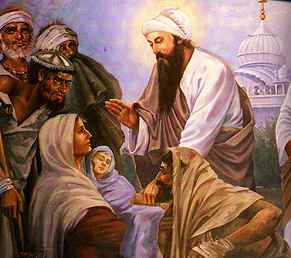
One day Mata Gujree jee while doing paath at amritvela, asked her son Guru Gobind Singh jee if she could have darshan of a brahmgiyaani as described in the 8th Ashtpadi of Siri Sukhmani Sahib.
Guru Sahib replied saying that the brahmgiyani Sikh would be at Siri Anandpur by noon that day. After saying this to Mata jee, Guru Sahib asked Ram Kuyer jee who lived at Lahore at that time, to come to Anandpur Sahib before noon.
Now we all know that there were no phones or telegram system at that time. Guru Sahib sent him the hukam through aatma. Bhai Raam Kuyer jee heard the hukam of Guru Sahib from within and thought to himself that it was not possible to reach Sri Anandpur Sahib from Lahore using normal means, before noon.
So he used his shakti and arrived at Siri Anandpur Sahib in a split second and met Mata jee.
This event is recorded in Sooraj Parkaash Granth and many other granths.
Baba Raam Kuyer jee was the great grandson of Pooran Brahmgiyaani Baba Budda jee.
Waheguru Ji Ka Khalsa Waheguru Ji Ki Fateh

Friday, March 03, 2006

End of the World???

Waheguru Ji Ka Khalsa Waheguru Ji Ki Fateh
Gurmat (Sikh Faith) preaches that just as the creater Waheguru created this world without consulting anyone, he take his creation back into non-existence without consulting anyone.
Till the world exists, good and bad will continue to happen but truth will always prevail. Sometimes the world order will seem to be very evil and dark but darkness will always be defeated by light of Waheguru.
Waheguru has now created his Khalsa - his own, and this Khalsa will definitely lighten up the world. At present time this light has reached only limited people in the world. In the future, by the hukam (order) of Akal Purakh, this divine light will reach everyone in the world. Khalsa that lives in the divine submission of Sri Guru Granth Sahib ji, is the only hope in the world.
Only Khalsa has access to the inner divine light - Waheguru. There are many others who claim to have the light but their claims are baseless. In the dark age of Kalyug, the torch of the divine light is in the hands of Waheguru's own manifestation - Sri Guru Nanak Dev jee.
Sri Guru Nanak Dev ji resides in Sri Guru Granth Sahib ji and his Khalsa. Whoever accepts Khalsa and Siri Guru Granth Sahib ji, shall be liberated from this terrible ocean of life and death.
End of this creation is not a subject of concern from Khalsa. Khalsa already knows that this visible world is an illusion. Whether this illusion disappears today or later, makes no difference to the Khalsa of Waheguru. Khalsa is the inheritor of the divine and eternal realm of Waheguru - Sachkhand. Worries of creation and destruction of this world don't concern Khalsa.
He is the clay He is the potter
What He does is all that matters
So many people claim to know
Yet He of His own accord runs this
show
People feel sorrow and delight
Who have not known His sacred sight
Those whose mind has become constant
Silently live the secret while others
rant
This world is but a tiny speck
Its life a mere flicker in infinity's aspect
The stars, moons, galaxies and quasars
All dance to His breath's rhythm close and
seemingly far.
What is there in a billion years?
Why should we shed so many tears?
For that which comes and that which goes
Is like a shadow, a dream to one who
knows
Waheguru keep me ever in Your will
I beg Thee keep my mind ever still
Like a calm lake on a clear day
Can mirror unrippled the view of Your
way.
Waheguru Ji Ka Khalsa Waheguru Ji Ki Fateh