Waheguru Ji Ka Khalsa Waheguru Ji Ki Fateh
Waheguru Ji Ka Khalsa Waheguru Ji Ki Fateh
Monday, July 31, 2006

Wednesday, July 26, 2006
Why did Guru Har Krishan Sahib Ji Maharaj get "sick"?
Waheguru Ji ka Khalsa Waheguru Ji Ki Fateh
To those who had seen the sick and the suffering being healed by Dhan Dhan Satguru Sri Guru Har Krishan Sahib Ji, it was incomprehensible as to why should the great Healer suffer from the same disease.
The first to lament and pose this question was a young Sikh disciple who asked, "Maharaj, saviour of the world, your glance and benediction cured the suffering and sickness of hundreds of people. You are the dispeller of sorrow and pain, whose glance and touch healed everyone. Why has this suffering come to you?"
Guru Sahib smiled at his beloved Sikh and replied. The suffering of "self consecration or the martyrdom of the Guru is in the redemptive spirit. The Guru is one with God's Light and Presence. His body, mind and soul never suffer any pain or sorrow, but he has to take upon himself the suffering of the human world in a human way. All great prophets and saints found the greatest joy in enduring the unendurable, in sharing the agony of fellow beings for the love of God. Even physical suffering is accepted by them as the gift of grace. To lessen other people's suffering is an act of compassion and charity but to suffer for the fulfilment of God's Will is an Apostle's response to the supreme love of God."
Waheguru Ji Ka Khalsa Waheguru Ji Ki Fateh
Thursday, July 13, 2006
For those who call themselves Sikhs
Waheguru Ji Ka Khalsa Waheguru Ji Ki Fateh
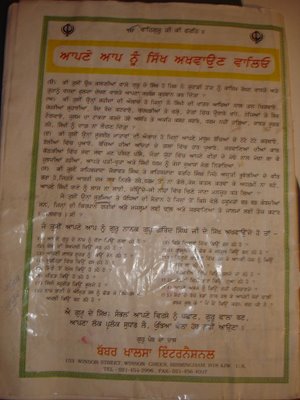 A. Are you the Sikhs of that Plume-adorned Divine Master (Kalgidhar Sri Guru Gobind Singh Ji), who sacrificed everything for the sake of your seeds’ continuity and prosperity?

For those who call themselves Sikhs
 A. Are you the Sikhs of that Plume-adorned Divine Master (Kalgidhar Sri Guru Gobind Singh Ji), who sacrificed everything for the sake of your seeds’ continuity and prosperity?
 B. Are you the descendants of those Great Shaheeds who, for the sake of Sikhi, were sawed and scalped alive, dismembered alive, broken on the wheels, boiled alive, hung their heads at spears, fighting tyranny underwent unbearable and unspeakable sufferings, but didn’t leave the faith, kept the Complete Divine Image intact (ie kept the Divine Hair) and didn’t let Sikhi get any spot of dirt?
C. Are you the sons/daughters of those brave warriors mothers, who let their innocent children get cut into pieces and taken into their laps, and their bodyparts adorned with flowers, and put 1,25 maunds of powder (bombs?) in the black houses of the tyrants, and fought side-by-side with their mighty warrior brothers, and kept their wifely duties and duties towards Sikhi with Keshan-Suasan [being steadfast with both Body-Hair and Soul-Breath]?
D. Are you the you the brothers and sisters of the Adutti-Bhuchangian [ie Amazing ’Small’ Beloved Warriors] like Sahibzada Zorawar Singh and Sahibzada Fateh Singh, who remained steadfast till their last breath, didn’t leave their faith, didn’t kill their hair and didn’t become non-religious, and didn’t bring shame upon the Sikhi BaNaa-Dress, as willingly accepted to be stacked alive in walls?
If you call yourself the Sikh of Guru Nanak-Guru Gobind Singh Ji, then:
1. Why are you letting your Guru’s Name down?
2. Why are you being disrespectful to your hair?
3. Why are you destroying your Complete Divine Image (Sabat Surat)?
4. Why are you indulging in sins?
5. Why are you turning your face away from Sikhi?
6. Why are you becoming a fallen (Patit)?
7. Why are you forgetting Sikh Code (Rehat)?
8. Why leaving Naam-Rass, the pleasure of Name, in the favor of the pleasure of drugs?
9. Why are you indulging in sexual wastes/sexual habits?
10. Why are you leaving the path of Gurmat, and turning towards path of human mind (manmukhta)?
11. Why are you indulging in petty acts and thereby ’making your turban dirty’ (ie loosing your respect)?
12. Why are you indulging in manmats?
13. Why are you loosing your uniqueness (Vilankhanta)?
14. Why don’t you recognize your real self?
15. Why have the children of lions forgotten their uniqueness and engaged with sheep? They have started saying ’main main’ (the sound made by sheep)?
Oh Sikhs of the Guru! Be Cautious and Keep intact your Identity, Become Guru-Valeh (GurSikhs). Bring Such a Reform so that all your generations have bliss. Lost Time will not come back!
Servants of Guru-Panth,
Babbar Khalsa International
Waheguru Ji Ka Khalsa Waheguru Ji Ki Fateh
When will you wake up to your religious duties?
Waheguru Ji Ka Khalsa Waheguru Ji Ki Fateh
More than a hundred years later we seem to be in the same situation.
Waheguru Ji Ka Khalsa Waheguru Ji Ki Fateh
We appeal before the Khalsa community and the government that the present committee for the management of the Golden Temple is neither based on the principles of the Khalsa panth nor on government legislation. If this committee was constituted on the basis of the Khalsa religion, its membership would have been made up of only the Khalsa. But at present this is not that case as Raja Harbans Singh, a committee member, is a Hindu, who professes beliefs contrary to that of a Khalsa, for instance idol worship. Similarly the deputy commissioner, another committee member, is a Christian. What benefit can accrue to the Khalsa community from having a Hindu Raja and a Christian deputy commissioner on the management body of its shrine? It is rather ironic that the gurudwara belongs to the community but its management it presided over by a deputy commissioner…As pointed out previously, the setting up of such a committee is not contravention of government legislation. The administration is not supposed to interfere in religious matters. Yet, a government official has been appointed as the president of a Khalsa gurudwara…Therefore we implore both the Khalsa community and the administration that this committee be improved and reconstituted. Oh Khalsa! When will you wake up to your religious duties? Do you not care for your scared shrines?
Khalsa Akhbar, 1st January 1887
Khalsa Akhbar, 1st January 1887
More than a hundred years later we seem to be in the same situation.
Waheguru Ji Ka Khalsa Waheguru Ji Ki Fateh
Monday, July 10, 2006
"Punjabi Suba Zindabad"
Waheguru Ji Ka Khalsa Waheguru Ji Ki Fateh
I have wanted to do a post on Punjabi Suba for a long time now. During my reading I came across this eyewitness account by Michael Brecher some time ago.
“First came the Sikhs in the most impressive – and peaceful – demonstration I have ever seen. Hour after hour and mile after mile they marched, eight abreast, down the main street of Amritsar, a hallowed name in Indian nationalism because of the shootings of 1919. Old and young, men and women, they came in an endless stream, most with an expression and sadness in their eyes, many still remembering the ghastly days of 1947 when their homeland was cut in two and hundreds of thousands fled before the Muslims, and when thousands of their co-religionists died or were maimed. What strength there was in the appearance of the older men who, with their flowing beards, looked like the Hebrew prophets of old! Many carried their traditional sword, the Kirpan, and many wore blue turbans, symbol of Sikh militancy. They had come from the villages and towns of the Punjab and from far-off places as well. Almost without exception they marched in an orderly file, portraying their unity of purpose. At intervals came the resounding cry, ‘Punjabi Suba Zindabad’ (Long live Punjabi Suba) and Master Tara Singh Zindabad, with intermittent music to enliven the proceedings. On they came, for five hours. Few watched them could doubt their genuine fear of being swallowed up in the vice-like embrace of rabid Hinduism. By conservative estimate they numbered 100,000. To this observer it seemed more like double that figure.”
Indian police attacked Darbar Sahib in 1955 for the first time, walked inside with shoes on, arrested Sikhs, disrespected Guru Granth Sahib Ji. Gurdwara Paonta Sahib was attacked in Himachal Pradesh where 16 Sikhs were shot dead inside the Gurdwara. Is this any different that British attacking Gurdwara Rakaab Ganj Sahib?
I have wanted to do a post on Punjabi Suba for a long time now. During my reading I came across this eyewitness account by Michael Brecher some time ago.
“First came the Sikhs in the most impressive – and peaceful – demonstration I have ever seen. Hour after hour and mile after mile they marched, eight abreast, down the main street of Amritsar, a hallowed name in Indian nationalism because of the shootings of 1919. Old and young, men and women, they came in an endless stream, most with an expression and sadness in their eyes, many still remembering the ghastly days of 1947 when their homeland was cut in two and hundreds of thousands fled before the Muslims, and when thousands of their co-religionists died or were maimed. What strength there was in the appearance of the older men who, with their flowing beards, looked like the Hebrew prophets of old! Many carried their traditional sword, the Kirpan, and many wore blue turbans, symbol of Sikh militancy. They had come from the villages and towns of the Punjab and from far-off places as well. Almost without exception they marched in an orderly file, portraying their unity of purpose. At intervals came the resounding cry, ‘Punjabi Suba Zindabad’ (Long live Punjabi Suba) and Master Tara Singh Zindabad, with intermittent music to enliven the proceedings. On they came, for five hours. Few watched them could doubt their genuine fear of being swallowed up in the vice-like embrace of rabid Hinduism. By conservative estimate they numbered 100,000. To this observer it seemed more like double that figure.”
Indian police attacked Darbar Sahib in 1955 for the first time, walked inside with shoes on, arrested Sikhs, disrespected Guru Granth Sahib Ji. Gurdwara Paonta Sahib was attacked in Himachal Pradesh where 16 Sikhs were shot dead inside the Gurdwara. Is this any different that British attacking Gurdwara Rakaab Ganj Sahib?
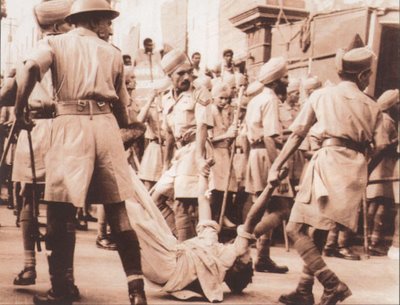
Hindus were given five days to get their anger out after Punjabi Suba was created. Sikhs were attacked in Haryana, Himachal, MP and other places. Hindus shouted slogans:
sUbI kw mjw cKWeyNgy, vwhgw pwr pucwieNgy [ aUVw eIVI nhI pVyNgy, jUVw jUVI kwt DryNgy [
Mughal killed Sikh children and today's Indian government is no different. A 10 years old Sikh boy Inderjit Singh was peacefully shouting the slogan "Punjabi Suba Jindabad" when he was thrown in the well and killed by indian police.
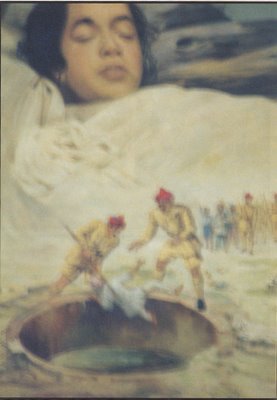 Those who call India their homeland need to pay a little visit to Sikh history and realize that though time has changed but situation, oppression and black laws against Sikhs have not changed. Those who do not learn from their history only live in history books.
Waheguru Ji Ka Khalsa Waheguru Ji Ki Fateh
Saturday, July 08, 2006
A Glimpse of Khalsa Raj
Waheguru Ji Ka Khalsa Waheguru Ji Ki Fateh
In spite of Bahadhur Shah's provocative orders of outright extirpation of the Sikhs, Baba Banda Singh Bahadhur Ji according to the royal newswriter, while at Kalanaur in April 1711, has promised and proclaimed:
"We do not oppress muslims or oppose Islam, but only tyranny and upsurpation of power. Accordingly, for any muslim who approaches him, he fixes a daily allowance and wages, and looks after him. He has permitted them to recite Khutba and Namaz. As such five hundred Muslims have gathered around him. Having entered into his friendship, they are free to shout their call - bang - and say their prayers - namaz - in the army of the wretched (Sikhs)".
Waheguru Ji Ka Khalsa Waheguru Ji Ki Fateh
Friday, July 07, 2006
As is Magahar, so is Benares; I see them as one and the same. Part 2
Waheguru Ji Ka Khalsa Waheguru Ji Ki Fateh
ਤੋਰੇ ਭਰੋਸੇ ਮਗਹਰ ਬਸਿਓ ਮੇਰੇ ਤਨ ਕੀ ਤਪਤਿ ਬੁਝਾਈ ॥
thorae bharosae magehar basiou maerae than kee thapath bujhaaee
Relying upon You, I can live even in the cursed place of Magahar; You have put out the fire of my body.
ਪਹਿਲੇ ਦਰਸਨੁ ਮਗਹਰ ਪਾਇਓ ਫੁਨਿ ਕਾਸੀ ਬਸੇ ਆਈ ॥2॥
pehilae dharasan magehar paaeiou fun kaasee basae aaee 2
First, I obtained the Blessed Vision of Your Darshan in Magahar; then, I came to dwell at Benares. 2
ਜੈਸਾ ਮਗਹਰੁ ਤੈਸੀ ਕਾਸੀ ਹਮ ਏਕੈ ਕਰਿ ਜਾਨੀ ॥
jaisaa magehar thaisee kaasee ham eaekai kar jaanee
As is Magahar, so is Benares; I see them as one and the same.
Virdev Singh Baghel, the king of Kashi, had constructed a beautiful palace. Everybody used to praise the palace.
King Virdev Singh was well aware of Bhagat Kabir ji’s spiritual glory. He had a fervent desire that Bhagat Kabir ji should visit the palace. He made persistent entreaties and finally managed to get Bhagat Kabir ji to accede to his request.
When Bhagat Kabir ji was about to leave after seeing the palace, the king enquired expectantly, “Your Holiness! What did you think about the palace?” The king expected Bhagat Kabir ji to praise the palace, but on the contrary, Bhagat Kabir ji said, “There are two major flaws in this palace.”
The King was shocked. He brooded, “I am the king of Kashi and there are two flaws in my palace!”
The king’s ego was deeply hurt. While everyone heartily praised the palace, here was Bhagat Kabir ji saying it had two major flaws. He asked, “Your Holiness! Please tell me what the two flaws are so that I may get them rectified at the earliest.”
“You cannot set them right,” Bhagat Kabir Ji said.
Bhagat Kabir ji was reluctant to elaborate but when the king insisted, he finally relented and said, “The palace has been built with great effort but the first flaw is that it will not accompany the owner after his death nor will the owner be able to live in the palace forever. The second flaw is that in due course of time the palace is destined to be reduced to ruins.”
It was as if the king had been slapped on his face. He felt hurt and his ego was bruised badly but Bhagat Kabir ji’s darshan, satsang and benign grace soon made him realise the truth, ‘What Bhagat Kabir ji says is absolutely true. I will not be able to live in this palace forever, nor will it accompany me at the time of death, and surely a time will come when the palace will turn into debris.’ He fell prostrate at Bhagat Kabirj i’s feet and became his devotee forever.
When Bhagat Kabir ji was about to depart from this world, he declared, “The work assigned to this body has been completed. Now it is time to get rid of this outer covering for which I will go to Magahar.”
When Virdev Singh was informed of this, he came running to Bhagat Kabir ji and pleaded, “Your Holiness! I had resolved that I would abandon my kingdom and serve you for five years in order to receive your spiritual grace. I had the desire to clean your cottage with my own hands, fetch water from the holy Ganges for you and knead the dough with my own hands to prepare rotis for you. I wanted to tread the path of God-realization under your benign tutelage, but I am utterly shocked to learn that you are going to Magahar for your final journey.”
Bhagat Kabir ji said, “It is too late, O King of Kashi!”
The water of the Ganges is flowing continuously. If you want you can take a dip in the holy waters. It is impossible to take a dip again in the same water that has already flowed past. So is the case with Saints and their satsang. When you come in the vicinity of a Saint, avail yourself of the opportunity right then and there. If you don’t, you will have to grieve over the lost opportunity.
The local populace were surprised to note that Bhagat Kabir ji wanted to leave his body at Magahar. People would come to Kashi during their last days and here Bhagat Kabir ji was leaving Kashi for Magahar.
People in general believe that if one breathes ones last in Kashi, one will attain salvation whereas dying in Magahar would only lead one to hell. Bhagat Kabir ji disregarded such popular superstitions in order to enlighten the people about the Supreme glory of the Lord’s grace and decided to discard his body at Magahar. When they came to know of this announcement, many Mullahs and pandits, accosted Bhagat Kabir ji and said, “All through your life you have been critical of us.”
‘If by worshipping a stone I could attain the Lord, I will rather worship a mountain. Better is the grinding stone that is useful in grinding grains to eat.'
‘Joining stones with mortar; They raise a high mosque, climbing to the top then, the Mullah shouts his prayer, but tell me O Mullah, Is the Lord deaf?’
Throughout your life, you have refuted our views. Lest the consequent sins should take you to hell, we suggest that you better spend your last days in Kashi that may ensure your emancipation after death.
Bhagat Kabir ji said, “No! Not at all! It is not that I shall attain salvation if I leave my body in Kashi and will be sent to hell if I breathe my last at Magahar. All places in this world belong to the Lord. Devotion to the Lord is of utmost import. Then how does it matter where a person breathes his last?
A person, with a cruel and unyielding mind having no devotion towards God, cannot escape hell even if he dies in Kashi. Then how can one, who is devoted to God, be born as a donkey, just because he died in Magahar? Not only will he himself be emancipated, but he will also enable his relatives, friends and followers to attain salvation.
ਜੈਸਾ ਮਗਹਰੁ ਤੈਸੀ ਕਾਸੀ ਹਮ ਏਕੈ ਕਰਿ ਜਾਨੀ ॥
jaisaa magehar thaisee kaasee ham eaekai kar jaanee
As is Magahar, so is Benares; I see them as one and the same.
In those days, it was believed that Magahar was afflicted with two curses: one was that anyone dying in Magahar would be reborn as a donkey and the second was that Magahar would always be in scarcity of water. To shatter these false beliefs Bhagat ji went to Magahar. It is said that once Bhagat Kabir ji set his foot in Magahar, the local river, Aami, that used to flow only during the rainy season started flowing throughout the year.
Waheguru Ji Ka Khalsa Waheguru Ji Ki Fateh
As is Magahar, so is Benares; I see them as one and the same.
Waheguru Ji Ka Khalsa Waheguru Ji Ki Fateh
ਤੋਰੇ ਭਰੋਸੇ ਮਗਹਰ ਬਸਿਓ ਮੇਰੇ ਤਨ ਕੀ ਤਪਤਿ ਬੁਝਾਈ ॥
thorae bharosae magehar basiou maerae than kee thapath bujhaaee
Relying upon You, I can live even in the cursed place of Magahar; You have put out the fire of my body.
ਪਹਿਲੇ ਦਰਸਨੁ ਮਗਹਰ ਪਾਇਓ ਫੁਨਿ ਕਾਸੀ ਬਸੇ ਆਈ ॥2॥
pehilae dharasan magehar paaeiou fun kaasee basae aaee 2
First, I obtained the Blessed Vision of Your Darshan in Magahar; then, I came to dwell at Benares. 2
ਜੈਸਾ ਮਗਹਰੁ ਤੈਸੀ ਕਾਸੀ ਹਮ ਏਕੈ ਕਰਿ ਜਾਨੀ ॥
jaisaa magehar thaisee kaasee ham eaekai kar jaanee
As is Magahar, so is Benares; I see them as one and the same.
One of the holiest city for the Hindus is Kanshi, which is also known as Banaras. Both Banaras and Kanshi are the names of the same city. Banaras is the commercial name of this city while Kanshi is the religious or Dharmik name of this city.
Devout Hindus believe that whoever dies in Kanshi goes straight to Shivpuri. Shivpuri is a place above Swarag (heaven) but much below Sach Khand. This is the place where Shiva the Hindu lord resides.
The bhagats of Shiva prefer to die in Kanshi, so that they may go straight to Shivpuri. In olden days, there were Karvats (cutting saw) in Kanshi, where old people used to pay Pandits to get cut by Karvat. They believed that if they give their life in Kanshi, they would go to Shivpuri. Pandits used to take away all the money of people committing suicide there. They used to promise them Shivpuri after death. Kanshi was the suicide capital of the world in those days.
Maghar is another city, that is not far from Kanshi. It is said that Vishvamitra the famous Hindu sage, planned to build a parallel city to Kanshi, where people who die would go to a higher dimension. Vishwamitra announced that whoever would die in Maghar would go to a higher destination than even Shivpuri.
People had great reverence for Vishwamitra and were aware of his spiritual power. They flocked to Maghar hoping to die there and go to a higher destination. A lot of people from Kanshi too started moving to Maghar and this infuriated Shiva very much as he was losing devotees to Vishwamitra.
Shiva and Vishnu devised a very good plan. I am not sure who was despatched with the duty to foil Vishwamitra’s plans to make Maghar the centre of the Hindu world but who ever went there was very shrewd and cunning. That person disguised as a poor and wretched person, went to Maghar to see Vishwamitra and asked him, “Maharishi jee, is it true that if I die in Maghar, I would go to a very high destination?”
Vishwamitra was very pleased to hear this and said, “Yes my son, if you die here, I promise that you will not go to hell and will go to a place higher than Shivpuri”.
About five minutes later that poor person approached Vishwamitra again and asked, “If I die here at Maghar, where will I go?”
Vishwamitra was very busy at that time and was a little annoyed hearing this person repeat his question again. He said, “My dear son, I already told you and I don't like to repeat again and again you will become someone higher than even the angels and will reside in a very beautiful place, above Shivpur”.
That guy left and came back again just few minutes later and accosted Vishwamitra who was very busy at that time. He asked the same question, “So Maharishi jee, what will I become if I die here at Maghar?”
Vishwamitra is known for his short temper. Great kings even, feared Vishwamitra and never did anything to upset him. Even Siri Krishna used to fear Vishwamitra for his maledictions. The whole generation and family of Siri Krishna was destroyed because of the curse of Vishwamitra. The Kauravs and Paandavs feared him and so did the Gandaars and Maghad Naresh. The only person who fixed Vishwamitra was King Amreek.
Anyway, when Vishwamtra heard that this highly stupid looking person had repeated his question to him, he angrily said, “Oye moorakh Nar, jo bhee yahaan maraega, voh Gardhab banaega” (O stupid rascal, whoever dies here will became a donkey in his next life”.
As soon as Vishwamitra said this, the poor person gave him a victory smile and disappeared from there. He had accomplished what he had come for. He took bachan from Maharishi Vishwamitra that whoever dies in Maghar would become a donkey. When other people heard about Vishwamitra’s bachan, they too fled the city. Kanshi again became the darling city of all Hindus.
So it is the faith of the Hindus that whoever dies in Maghar becomes a donkey and whoever dies in Kanshi goes to Shivpuri.
Waheguru Ji Ka Khalsa Waheguru Ji Ki Fateh
ਤੋਰੇ ਭਰੋਸੇ ਮਗਹਰ ਬਸਿਓ ਮੇਰੇ ਤਨ ਕੀ ਤਪਤਿ ਬੁਝਾਈ ॥
thorae bharosae magehar basiou maerae than kee thapath bujhaaee
Relying upon You, I can live even in the cursed place of Magahar; You have put out the fire of my body.
ਪਹਿਲੇ ਦਰਸਨੁ ਮਗਹਰ ਪਾਇਓ ਫੁਨਿ ਕਾਸੀ ਬਸੇ ਆਈ ॥2॥
pehilae dharasan magehar paaeiou fun kaasee basae aaee 2
First, I obtained the Blessed Vision of Your Darshan in Magahar; then, I came to dwell at Benares. 2
ਜੈਸਾ ਮਗਹਰੁ ਤੈਸੀ ਕਾਸੀ ਹਮ ਏਕੈ ਕਰਿ ਜਾਨੀ ॥
jaisaa magehar thaisee kaasee ham eaekai kar jaanee
As is Magahar, so is Benares; I see them as one and the same.
One of the holiest city for the Hindus is Kanshi, which is also known as Banaras. Both Banaras and Kanshi are the names of the same city. Banaras is the commercial name of this city while Kanshi is the religious or Dharmik name of this city.
Devout Hindus believe that whoever dies in Kanshi goes straight to Shivpuri. Shivpuri is a place above Swarag (heaven) but much below Sach Khand. This is the place where Shiva the Hindu lord resides.
The bhagats of Shiva prefer to die in Kanshi, so that they may go straight to Shivpuri. In olden days, there were Karvats (cutting saw) in Kanshi, where old people used to pay Pandits to get cut by Karvat. They believed that if they give their life in Kanshi, they would go to Shivpuri. Pandits used to take away all the money of people committing suicide there. They used to promise them Shivpuri after death. Kanshi was the suicide capital of the world in those days.
Maghar is another city, that is not far from Kanshi. It is said that Vishvamitra the famous Hindu sage, planned to build a parallel city to Kanshi, where people who die would go to a higher dimension. Vishwamitra announced that whoever would die in Maghar would go to a higher destination than even Shivpuri.
People had great reverence for Vishwamitra and were aware of his spiritual power. They flocked to Maghar hoping to die there and go to a higher destination. A lot of people from Kanshi too started moving to Maghar and this infuriated Shiva very much as he was losing devotees to Vishwamitra.
Shiva and Vishnu devised a very good plan. I am not sure who was despatched with the duty to foil Vishwamitra’s plans to make Maghar the centre of the Hindu world but who ever went there was very shrewd and cunning. That person disguised as a poor and wretched person, went to Maghar to see Vishwamitra and asked him, “Maharishi jee, is it true that if I die in Maghar, I would go to a very high destination?”
Vishwamitra was very pleased to hear this and said, “Yes my son, if you die here, I promise that you will not go to hell and will go to a place higher than Shivpuri”.
About five minutes later that poor person approached Vishwamitra again and asked, “If I die here at Maghar, where will I go?”
Vishwamitra was very busy at that time and was a little annoyed hearing this person repeat his question again. He said, “My dear son, I already told you and I don't like to repeat again and again you will become someone higher than even the angels and will reside in a very beautiful place, above Shivpur”.
That guy left and came back again just few minutes later and accosted Vishwamitra who was very busy at that time. He asked the same question, “So Maharishi jee, what will I become if I die here at Maghar?”
Vishwamitra is known for his short temper. Great kings even, feared Vishwamitra and never did anything to upset him. Even Siri Krishna used to fear Vishwamitra for his maledictions. The whole generation and family of Siri Krishna was destroyed because of the curse of Vishwamitra. The Kauravs and Paandavs feared him and so did the Gandaars and Maghad Naresh. The only person who fixed Vishwamitra was King Amreek.
Anyway, when Vishwamtra heard that this highly stupid looking person had repeated his question to him, he angrily said, “Oye moorakh Nar, jo bhee yahaan maraega, voh Gardhab banaega” (O stupid rascal, whoever dies here will became a donkey in his next life”.
As soon as Vishwamitra said this, the poor person gave him a victory smile and disappeared from there. He had accomplished what he had come for. He took bachan from Maharishi Vishwamitra that whoever dies in Maghar would become a donkey. When other people heard about Vishwamitra’s bachan, they too fled the city. Kanshi again became the darling city of all Hindus.
So it is the faith of the Hindus that whoever dies in Maghar becomes a donkey and whoever dies in Kanshi goes to Shivpuri.
Waheguru Ji Ka Khalsa Waheguru Ji Ki Fateh
Thursday, July 06, 2006
Indian Justice
Waheguru Ji Ka Khalsa Waheguru Ji Ki Fateh
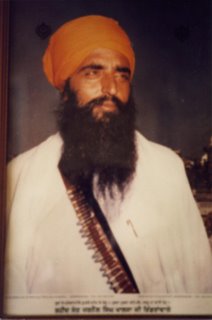
Sant Gyani Baba Jarnail Singh Ji Khalsa Bhindranwale speaking about Indian Justice.
Waheguru Ji Ka Khalsa Waheguru Ji Ki Fateh
'Khalsa Ji, one gets justice out of inquiries when there is room for legal representation, argument, and appeal. Here (under Indian Government) it is outright injustice. They have decided to annihilate the Sikhs, to insult their turban, to destroy their Faith. Under this situation, why do you need to use a lawyer and appeal?'
'Khalsa Ji, what assurance, what justice, what fairness can you expect from a Government, from courts, which no longer trust people, which have lost all faith in men and trust only dogs? How can you expect justice from them? Those who have no faith in men, those who have no faith in the legal process, in reasoning, and in appeal to conscience of the perpetrators; those who only trust dogs, but if the dogs point to their own house as the source of crime, they don't trust the dogs either.'
Sant Gyani Baba Jarnail Singh Ji Khalsa Bhindranwale speaking about Indian Justice.
Waheguru Ji Ka Khalsa Waheguru Ji Ki Fateh
Tuesday, July 04, 2006
Bhagat Puran Singh on Bhagti
Waheguru Ji Ka Khalsa Waheguru Ji Ki Fateh
- If you make your morning, you've made your day. Don't be irritated by trivial matters. Make sure you take time in the morning for silent, solitary reflection.
- Daily have a talk with God. He is a true friend and "It is so natural to discuss with a friend your ambitions and aspirations, your plans and programmes, your failures and frustrations and ask him to help you". We may not be able to at first see him or hear him, but be certain that he does see and hear you. We will meet God only when he is sure that "your truly need Him and nothing besides."
- Prayer is not easy: "A holy man driving a car, met a beggar on the way. The beggar exclaimed, "If only I too became a holy man, a man of prayer, I would have a car!""Prayer is not that easy" said the holy man. "If you say too(n) thaakur tum pai ardaas... with a concentated mind, the car (and much more) can belong to you""Wonderful!" Said the astonished beggar. Joining his hands and closing his eyes he said the prayer aloud, "Too(n) thakur tum pai ardaas. Jeeo pind sabhi teree raas..."Suddenly in mid prayer, his eyes opened up and he asked, "Shall I have a garage along with car? Else where would I keep it???" Moral: concentrated prayer is not an easy task.
- Make God your life partner: He can be a partner in your daily life and all activities and miracles can happen. Rest assured that there is no problem which you and God cannot solve together and no situation you cannot handle together.
- A loving relationship is based on a feeling of being needed. Think about when you have felt closest to someone. It is quite possibly a time when you have been needed by them. Feeling needed and wanted is something that fosters love not only between humans but also with God. When God knows you need him and only him and have no other support, he will then come to you.
Waheguru Ji Ka Khalsa Waheguru Ji Ki Fateh
Thursday, June 15, 2006
The King of Martyrs
Waheguru Ji Ka Khalsa Waheguru Ji Ki Fateh
We celebrated the 400th anniversary of Guru Sahib's (physical) shaheedi on the 31st of May. I meant to do a post on our beloved Guru Ji then but some other things came in the way unfortunately.
We celebrated the 400th anniversary of Guru Sahib's (physical) shaheedi on the 31st of May. I meant to do a post on our beloved Guru Ji then but some other things came in the way unfortunately.
Mian Mir, the Muslim saint of Lahore, also went and contributed his sympathetic tears. He found Guru Jis body all blistered and suppurated, and requested his permission to appeal to the Emperor for his release and the punishment of his torturers. Guru Ji requested him to cast his eyes towards the heavens.
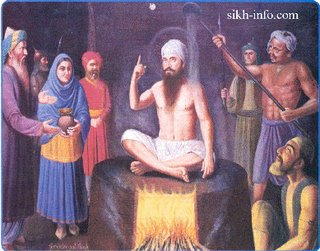 On doing so, Mian Mir saw angels begging Guru Jis permission to destroy the wicked and the proud. Mian Mir on beholding this supernatural vision asked Guru Ji, why when he possessed supernatural power, he consented to endure suffering at the hands of such vile sinners.
 Guru Ji replied, 'I bear all this torture to set an example to the teachers of the true name, that they may not lose patience or rail at God in affliction. The true test of faith is in the hour of misery. Without examples to guide them ordinary persons' minds quail in the midst of suffering. In the second place, if he who possesseth power within him defend not his religion by the open profession thereof, the man who possesses no such power when put to the torture abjure his faith. The sin will light on the head of him who has the power but does not show it; and god will deem him an enemy of religion. In the third place, the body is naturally subjected to woe and weal, but not the spirit. The body is perishable, the soul is imperishable. To set aside by the exercise of supernatural power the law of nature which applies to all things perishable. and thereby to, engender pride in the heart, would be supreme folly.'
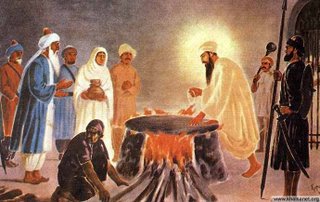 Dhan Dhan Satguru Sri Guru Arjan Dev Ji Maharaj
Waheguru Ji Ka Khalsa Waheguru Ji Ki Fateh
Tuesday, June 13, 2006
Killing the Five Evils: Overcoming Lust (Kaam) Part 5
Waheguru Ji Ka Khalsa Waheguru Ji Ki Fateh
This will be the final post on Kaam.
There is a parsang of Guru Nanak Dev Ji blessing gyan to Emperor Shivnaabh. Upon gaining the grace of Guru Nanak Sahib Ji, the emperor asked Guru Sahib to bless him with gyaan and Guru Sahib at that time mentioned many different virtues which are important and Guru Sahib also told him to stay away from kaam, even in thoughts. Guru Sahib mentioned that there is kaam of 8 kinds, which takes steps and the ‘stages’ increase from one to the next if one fails to control the initial stage. Here is the exact passage from that Sri Guru Nanak Parkash:
This will be the final post on Kaam.
There is a parsang of Guru Nanak Dev Ji blessing gyan to Emperor Shivnaabh. Upon gaining the grace of Guru Nanak Sahib Ji, the emperor asked Guru Sahib to bless him with gyaan and Guru Sahib at that time mentioned many different virtues which are important and Guru Sahib also told him to stay away from kaam, even in thoughts. Guru Sahib mentioned that there is kaam of 8 kinds, which takes steps and the ‘stages’ increase from one to the next if one fails to control the initial stage. Here is the exact passage from that Sri Guru Nanak Parkash:
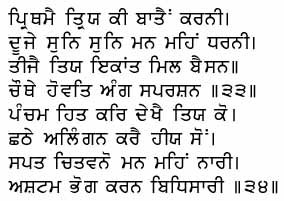
First stage is of talking to one another about those of other sex. And the next stage occurs when one starts thinking of such talks by himself and others in his mind. Third stage occurs when one meets those of other sex in person. Fourth is when one touches the other person. Fifth is when s/he looks at others with an urging interest. Sixth is when that person touches the other with having lustful desires. Seventh is when that person constantly keeps on thinking of the other person in his mind. Eighth is when he fulfills the desires of his mind.
As we can see that the first few stages might not seem very objectionable but later on the stages start becoming obvious and if the person does happen to enter any of the final stages I believe that is when the person ruins everything up for himself.
So to save ourselves from such stages it’s important that we stay away from the early ones.
By: Saffajang Singh
Waheguru Ji Ka Khalsa Waheguru Ji Ki Fateh
Killing the Five Evils: Overcoming Lust (Kaam) Part 4
Waheguru Ji Ka Khalsa Waheguru Ji Ki Fateh
Ishq-e-Haqeeqi Vs Ishq-e-Mizaajee
As written by Bhai Nandlal jee, the majnoo of Vaheguru does not fall for a worldly beauty like Laila:
MAJNOON-E-TAU KAI AASHIQ-E-LAILA BAASHAD
Our Guru Sahibaan expects his Sikh to be an Aashiq (premi, lover) not of a worldly beauty but of Vaheguru. In Siri Aasa kee Vaar, Siri Guru jee states:
IH, KINEYI AASHIQEE, JE DOOJAI LAGAI JAAYE
(What kind aashiqee i.e. love is this, that permits to love someone else, other than your beloved Vaheguru?)
NANAK, AASHIQ KAANDHIYE, SADD HEE RAHAI SAMAAYE
(Guru Angad Sahib writes that the true aashiq is so who stays forever merged in Vaheguru)
Look how high the ideal of love in Sikhi is and how lowly the worldly (ishq-e-mazaajee) love is. Gurmat preaches that we should be such lovers of Vaheguru that we should stay forever in his yaad (sweet rememberence).
Is there anything that the lovers of Vaheguru have not done for their love? The true aashiqs of Vaheguru have sat on red hot pans and had hot sand pour over them. They had their head severed in love for their beloved. They let the aggressors burn them alive in cotton but they did not even once let their love for their beloved one go down. They were cut in half. They were boiled alive. They were made to roll over the killer wheels.
The aashiqs of Vaheguru gave their lives at one signal from their beloved Guru. They had their skulls removed for their beloved. They had their children cut into pieces for their beloved one.
The aashiqs of Vaheguru spent their youths in jails but did not let their love go down. They kept their rehit intact and against all odds obeyed the hukam of their beloved.
This is what aashiqs of Vaheguru did. What did Vaheguru do in return? Vaheguru in return gave them immense bliss of Naam Rass and gave them everlasting spot in Sach Khand.
Now let us look at the lives of worldly aashiqs. They too sacrificed a lot. Kaiz who is popularly known as Majnoo gave up his royal status for Laila, his beloved. He went city to city for her and in the end perished in the deserts of Arabia. What did he get in return from Laila? Nothing substantial.
Ranjha, gave up Takhat Hazaara and for a dozen years worked as a servant for Choochak (father of Heer). He became a diwaana of Heer but what did Heer do in the end? She married someone else and left for her in-laws at Rangpur KheRa. Poor Dheedo (Raanjha) become a jogi.
Sassee perished in the desert for Punoo and Sohni pershised in river chanaa for Mahivaal. What did they get in return?
This way we can give several examples of failure of ishq-e-mizaajee. In the case of Laila Majnoo, what could have been the possible peak of this love? At the most Majnoo would have married Laila. So is this an everlasting relationship? Not according to baani.
On the other hand, Bhai Taaroo Singh jee had his skull removed by the Muslims, out of love for Siri Guru Gobind Singh jee. What did Bhai Taaroo Singh jee get in return? He already had Naam Rass and now he became one with Vaheguru and is now in Sach Khand with Vaheguru.
I don't have any doubts over the intentions of Raanjha and Majnoo. Even Bhai Gurdas jee has praised their spirit and hard work but the reality is that the end result of this love is not that great.
Reading baani we learn that the true aashiqs i.e. the Gursikhs of Guru Nanak Dev jee, succeed in getting good results out of their hard work. The worldly aashiqs too are of two categories - ones who are inspired by kaam (99%) and the ones inspired by love for soul e.g. Ranjha, Majnoo etc. The ones inspired by Kaam surely go to hell and the ones like Ranjha and Majnoo too cannot achieve anything high according to baani, because baani preaches that one gets what one aims for and if these guys Ranjha and Majnoo were to get their love, what would they really gain from that? At the most they may marry their love in the next life and then have children from them. Would it result in everlasting rest? No! It will surely put them back in chauraasee (8.4 million life forms). There will be no way out.
According to baani, only those ones, who become aashiqs of Vaheguru, get any real results for their hard work. Rest waste their time.
In the light of all this, is it not our duty to deliver ourselves by dying on the Amrit Naam of Satguru? Is it not our duty to never miss amritvela and during amritvela japp naam with full concentration?
May Guru Sahib make us his real aashiqs. Gurbani is calling out to us, to take precaution during our youth. During the youth time, there is high probability of making a mistake that can leave a scar on the life of Gursikh for rest of his life. It is not worth it.
By: Bhai Kulbir Singh
Waheguru Ji Ka Khalsa Waheguru Ji Ki Fateh
Friday, June 09, 2006
Killing the Five Evils: Overcoming Lust (Kaam) Part 3
Waheguru Ji Ka Khalsa Waheguru Ji Ki Fateh
ਦੇਖਿ ਪਰਾਈਆਂ ਚੰਗੀਆਂ ਮਾਵਾਂ ਭੈਣਾਂ ਧੀਆਂ ਜਾਣੈ ॥
"Men should look at the opposite sex as mothers, sisters and daughters, (women should look at the opposite sex as fathers, brothers and sons)." (Var. 29, Pauri 11, Bhai Gurdas ji)
A Singh had rescued some Hindu Princess from the invaders. The princess was considered one of the most beatiful women in India. She along with others had been kidnapped to be taken back to Afghanistan and a Jatha of Singhs had rescued them.
The Singh that rescued her put her on his horse and began to take her back to her home. The Singh himself was very tall and strong and seeing his way of life on their journey, she asked that he not take her back and instead marry her.
The Singh paid no mind to her request and kept going and dropped her off and then returned to his Jatha.
When the other Singhs asked what had happend and he told them, one Singh asked, "Veer ji, she is considered the most beatiful woman in the North, did you not feel any desire or weakness on the journey or when she proposed to you?"
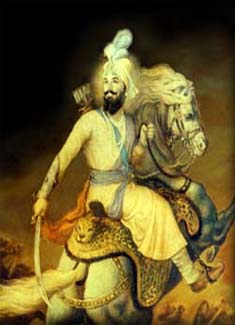
The Singh replied, "On one side before me stood a form made of mud, filled with filth and crumbling slowly with age. On the other side stood the eternal form of Dashmesh pita, glowing and forever present. What choice was there?"
 Here are some other posts about Kaam which I encourage you to read: Panthic Otpreka,
Fighting Kaam, Shabad Kaam Maran Deh.
Waheguru Ji Ka Khalsa Waheguru Ji Ki Fateh
ਦੇਖਿ ਪਰਾਈਆਂ ਚੰਗੀਆਂ ਮਾਵਾਂ ਭੈਣਾਂ ਧੀਆਂ ਜਾਣੈ ॥
"Men should look at the opposite sex as mothers, sisters and daughters, (women should look at the opposite sex as fathers, brothers and sons)." (Var. 29, Pauri 11, Bhai Gurdas ji)
A Singh had rescued some Hindu Princess from the invaders. The princess was considered one of the most beatiful women in India. She along with others had been kidnapped to be taken back to Afghanistan and a Jatha of Singhs had rescued them.
The Singh that rescued her put her on his horse and began to take her back to her home. The Singh himself was very tall and strong and seeing his way of life on their journey, she asked that he not take her back and instead marry her.
The Singh paid no mind to her request and kept going and dropped her off and then returned to his Jatha.
When the other Singhs asked what had happend and he told them, one Singh asked, "Veer ji, she is considered the most beatiful woman in the North, did you not feel any desire or weakness on the journey or when she proposed to you?"
The Singh replied, "On one side before me stood a form made of mud, filled with filth and crumbling slowly with age. On the other side stood the eternal form of Dashmesh pita, glowing and forever present. What choice was there?"
 Here are some other posts about Kaam which I encourage you to read: Panthic Otpreka,
Fighting Kaam, Shabad Kaam Maran Deh.
Waheguru Ji Ka Khalsa Waheguru Ji Ki Fateh
Thursday, June 08, 2006
Killing the Five Evils: Overcoming Lust (Kaam) Part 2
Waheguru Ji Ka Khalsa Waheguru Ji Ki Fateh
The Emperor said to Satguru Sri Guru Har Gobind Sahib Ji Maharaj, 'You are a very young man. Many beautiful women come to see you. It is extremely hard to subdue youthful passions. How do you O True King succeed in doing so?'
 Satguru Ji said, 'Dear Brother, there was once a very religious and chaste man who had conquered his passions. A lewd and adulterous king used to wait on this man. The saint once asked him what desire he sought to gratify by his attention to him.
Satguru Ji said, 'Dear Brother, there was once a very religious and chaste man who had conquered his passions. A lewd and adulterous king used to wait on this man. The saint once asked him what desire he sought to gratify by his attention to him.The King replied, 'I am a lustful man. I ever desire sexual pleasures and the gratification of all my desires.'
The Saint replied, 'Because of this enjoyment you have only eight more days of your life to live, which you may enjoy as you please. On the ninth day you will surely die.'
The King, was very worried and asked the saint if there was anything that he could do to avert his fate.
The Saint replied, 'Meditate on the name of Waheguru.'
The King, left the saint and hurried home..... He abandoned all worldly affairs, and so applied himself to devotion of the name of Waheguru so that all impure desires left his mind.
The ninth day came, and the King went to the Saint and informed him of how he had spent his time since their last meeting. The saint then said, that his life was saved by the power of his devotion and then asked him how he had abandoned sensuality.
The King replied, that it was through the fear of impending death....
The saint smiled, looked at the king and said, 'that is an answer to the question you asked. That is the way to avert your fate. You thought that you will die in eight days, so no evil desires entered your mind, while as for myself, I am not certain that that death will not come and seize me at any moment. On this account my mind is unswayed by passion.'
Satguru Ji then said, 'O Emperor Jahangir, there is no reliance to be placed on death; it comes like a thief when we expect it not to come. If a man had information, he would not allow things to be stolen from his house.'
Waheguru Ji Ka Khalsa Waheguru Ji Ki Fateh
Wednesday, June 07, 2006
Killing the Five Evils: Overcoming Lust (Kaam) Part 1
Waheguru Ji Ka Khalsa Waheguru Ji Ki Fateh
People often say that the most detrimental of all mistakes a Sikh could make is to get involved in a relationship with the opposite sex. This doesn't necessarily mean being physically involved, but even something as "harmless" as developing feelings for another person outside of marriage can cost you everything. It seems almost impossible to recover after such a mistake. Even months and months later, there seems to be no escape in sight from all the damage it causes on a spiritual level.

There was once a young Singh, perhaps in his early 20's, who used to do sevaa in Punj Pyaaray with Bhai Sahib Randhir Singh Jee. What a high avastha that youth must have had to do sevaa amongst such chardi kalaa Gursikhs. Bhai Sahib used to warn this youth to limit his interactions and communications with the opposite sex. He was warned to be careful and to talk to bibiaan less.
However, this youth, like many of us, probably gave himself a lot of credit. He probably doubted that he could fall prey to the enticement of maya and doubted he would be tempted by kaam.
But, lo and behold, he fell. And very badly, too. He committed such a grave mistake that warranted presenting himself before the Punj Pyaaray to seek forgiveness.
He traveled to a Smaagam to get peshed, but the Punj Pyaaray there told him to return to his hometown and get peshed there in a local Amrit Sinchaar. This youth however was extremely ashamed of his mistake and had too much pride to present himself before his local Sangat. So, instead of getting peshed and trying to continue on with his Sikhi, this Singh disappeared altogether and no one ever saw or heard from him again. Some say that he committed suicide since he was never seen again.
Drastic measures? I think not. It just shows how grave the mistake can be and just how detrimental it is, often to the point of no return.This youth didn't heed Bhai Sahib's advice to steer clear of being close with the opposite gender, so who would heed my advice now? All I can say is that the stakes are very high and if a Singh of such a high spiritual avastha can fall, what makes us think we can't? I see so many youth today who are clearly emotionally attached and involved with one another in the form of a "crush" if not more. They think they are safe and their relationships are acceptable and they won't cross the line by falling prey to kaam.
But I say you've already fallen once you've developed feelings of this nature for a member of the opposite sex. And I tell you, it could happen to anyone, so it's best to be vigilant. We are all like wax that will easily melt when placed in the vicinity of fire. We're better off keeping a distance from the flame because after melting, there's no going back. Try as you might, sometimes it seems that the damage is irreparable.
I'm not sure who wrote this but it echos most of the things I wanted to say. I will post some of my own thoughts on this next time, along with an amazing sakhi about Dhan Dhan Satguru Sri Guru Hargobind Sahib Ji Maharaj which relates to this vice.
Waheguru Ji Ka Khalsa Waheguru Ji Ki Fateh
Friday, June 02, 2006
ਮਿਤ੍ਰ ਪਿਆਰੇ ਨੂੰ ਹਾਲ ਮੁਰੀਦਾਂ ਦਾ ਕਹਿਣਾ
Waheguru Ji Ka Khalsa Waheguru Ji Ki Fateh
ਖਿਆਲ ਪਾਤਿਸ਼ਾਹੀ ੧੦॥
KHYAL OF THE TENTH KING
ਮਿਤ੍ਰ ਪਿਆਰੇ ਨੂੰ ਹਾਲ ਮੁਰੀਦਾਂ ਦਾ ਕਹਿਣਾ ॥
Convey to the dear friend the condition of the disciples,
ਤੁਧੁ ਬਿਨੁ ਰੋਗੁ ਰਜਾਈਆਂ ਦਾ ਓਢਣ ਨਾਗ ਨਿਵਾਸਾਂ ਦੇ ਰਹਿਣਾ ॥
Without Thee, the taking over of quilt is like disease and living in the house is like living with serpents;
ਸੂਲ ਸੁਰਾਹੀ ਖੰਜਰੁ ਪਿਆਲਾ ਬਿੰਗ ਕਸਾਈਆਂ ਦਾ ਸਹਿਣਾ ॥
The flask is like the spike, the cup is like a dagger and (the separation) is like enduring the chopper of the butchers,
ਯਾਰੜੇ ਦਾ ਸਾਨੂੰ ਸੱਥਰੁ ਚੰਗਾ ਭੱਠ ਖੇੜਿਆਂ ਦਾ ਰਹਿਣਾ ॥੧॥੧॥
The pallet of the beloved Friend is most pleasing and the worldly pleasures are like furnace.
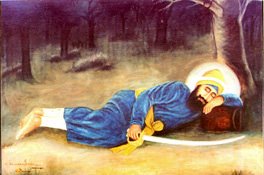 Dhan Dhan Satguru Sri Guru Gobind Singh Ji Maharaj, the King of Kings and the Saint of Saints
Waheguru Ji Ka Khalsa Waheguru Ji Ki Fateh
ਖਿਆਲ ਪਾਤਿਸ਼ਾਹੀ ੧੦॥
KHYAL OF THE TENTH KING
ਮਿਤ੍ਰ ਪਿਆਰੇ ਨੂੰ ਹਾਲ ਮੁਰੀਦਾਂ ਦਾ ਕਹਿਣਾ ॥
Convey to the dear friend the condition of the disciples,
ਤੁਧੁ ਬਿਨੁ ਰੋਗੁ ਰਜਾਈਆਂ ਦਾ ਓਢਣ ਨਾਗ ਨਿਵਾਸਾਂ ਦੇ ਰਹਿਣਾ ॥
Without Thee, the taking over of quilt is like disease and living in the house is like living with serpents;
ਸੂਲ ਸੁਰਾਹੀ ਖੰਜਰੁ ਪਿਆਲਾ ਬਿੰਗ ਕਸਾਈਆਂ ਦਾ ਸਹਿਣਾ ॥
The flask is like the spike, the cup is like a dagger and (the separation) is like enduring the chopper of the butchers,
ਯਾਰੜੇ ਦਾ ਸਾਨੂੰ ਸੱਥਰੁ ਚੰਗਾ ਭੱਠ ਖੇੜਿਆਂ ਦਾ ਰਹਿਣਾ ॥੧॥੧॥
The pallet of the beloved Friend is most pleasing and the worldly pleasures are like furnace.
 Dhan Dhan Satguru Sri Guru Gobind Singh Ji Maharaj, the King of Kings and the Saint of Saints
Waheguru Ji Ka Khalsa Waheguru Ji Ki Fateh
Thursday, May 25, 2006
Does EVIL exist?
Waheguru Ji Ka Khalsa Waheguru Ji Ki Fateh
This is an interesting email that my dad sent me today.
Does EVIL exist?
A University professor at a well-known institution of higher learning challenged his students with this question. "Did God create everything that exists?" A student bravely replied, "Yes he did!" "God created everything?" The professor asked. "Yes sir, he certainly did," the student replied. The professor answered, "If God created everything; then God created evil. And, since evil exists, and according to the principle that our works define who we are, then we can assume God is evil."
The student became quiet and did not answer the professor's hypothetical definition. The professor, quite pleased with himself, boasted to the students that he had proven once more that the Christian faith was a myth.
Another student raised his hand and said, "May I ask you a question, professor?" "Of course", replied the professor. The student stood up and asked, "Professor, does cold exist?" "What kind of question is this? Of course it exists. Have you never been cold?" The other students snickered at the young man's question.
The young man replied, "In fact, sir, cold does not exist. According to the laws of physics, what we consider cold is in reality the absence of heat. Every body or object is susceptible to study when it has or transmits energy, and heat is what makes a body or matter have or transmit energy. Absolute zero (-460 F) is the total absence of heat. And all matter becomes inert and incapable of reaction at that temperature. Cold does not exist. We have created this word to describe how we feel if we have no heat." The student continued, "Professor, does darkness exist?" The professor responded, "Of course it does."
The student replied, "Once again you are wrong, sir, darkness does not exist either. Darkness is in reality the absence of light. Light we can study, but not darkness. In fact, we can use Newton's prism to break white light into many colors and study the various wavelengths of each color. You cannot measure darkness. A simple ray of light can break into a world of darkness and illuminate it. How can you know how dark a certain space is? You measure the amount of light present. Isn't this correct? Darkness is a term used by man to describe what happens when there is no light present."
Finally the young man asked the professor, "Sir, does evil exist?" Now uncertain, the professor responded, "Of course, as I have already said. We see it everyday. It is in the daily examples of man's inhumanity to man. It is in the multitude of crime and violence everywhere in the world. These manifestations are nothing else but evil."
To this the student replied, "Evil does not exist, sir, or at least it does not exist unto itself. Evil is simply the absence of God. It is just like darkness and cold, a word that man has created to describe the absence of God. God did not create evil. Evil is the result of what happens when man does not have God's love present in his heart. It's like the cold that comes when there is no heat, or the darkness that comes when there is no light." The professor sat down.
The young man's name -- Albert Einstein
Waheguru Ji Ka Khalsa Waheguru Ji Ki Fateh
Wednesday, May 24, 2006
Killing the Five Evils: Overcoming Anger (Krodh)
Waheguru Ji Ka Khalsa Waheguru Ji Ki Fateh
sloku ]salok
Salok:
kwm k®oD Aru loB moh ibnis jwie AhMmyv ]kaam krodhh ar lobh moh binas jaae aha(n)maevSexual desire, anger, greed and emotional attachment - may these be gone, and egotism as well.
nwnk pRB srxwgqI kir pRswdu gurdyv ]1]naanak prabh saranaagathee kar prasaadh guradhaev 1Nanak seeks the Sanctuary of God; please bless me with Your Grace, O Divine Guru. 1
sloku ]salok
Salok:
kwm k®oD Aru loB moh ibnis jwie AhMmyv ]kaam krodhh ar lobh moh binas jaae aha(n)maevSexual desire, anger, greed and emotional attachment - may these be gone, and egotism as well.
nwnk pRB srxwgqI kir pRswdu gurdyv ]1]naanak prabh saranaagathee kar prasaadh guradhaev 1Nanak seeks the Sanctuary of God; please bless me with Your Grace, O Divine Guru. 1
Anger
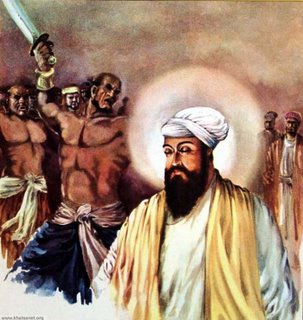
Satguru Sri Guru Tegh Bahadhur Ji Maharaj, the king of kings, the saint of saints and the blanket of the world said to his sikhs, 'In anger man commits evil deeds. He loses at once his senses, and his religion. When anger springs up in a man's heart, what crime is there he will not perpetrate?'
He thinks nothing of sinning against his parents and his holy Guru. He takes the life which he ought to protect, and utters nothing but harsh language. He will not refrain from any act even though he sacrifices his life in its execution. There is no greater sacrifice than life, and yet the foolish person will deliberately make it. The angry man's soul burns if he does not obtain his desires. He cannot eat or sleep. Day and night he is tortured by his passion, and forms endless plans for its gratification. In this way he passes his time in misery.
Forgiveness
'To exercise forgiveness is a great act. To exercise forgiveness is to give alms. Forgiveness is equal to ablutions at all places of pilgrimage. Forgiveness ensures man's salvation. There is no virtue equal to forgiveness.'
'Whenever you get the chance generously exercise it. Never abandon this virtue, but ever preserve it in your hearts. You are ordered in the Granth Sahib (Guru Granth Sahib Ji Maharaj) to lay up the wealth of the Name, so that it may accompany you in this world and in the next.'
'This wealth is only found in the companionship of good men, and cannot be obtained by any other means. My followers possess this wealth which is superior to all jewels and gems. The saints hoard it day and night.'
'It cannot be purchased, no thief can steal, no fire consume, no water drown it, whereas worldly wealth is generally accumulated by sin. Thieves can steal it, pickpockets purloin it, kings seize it, fire burn it, and earth rot it. At the hour of death this sinful wealth only causes regret, and, through man's desires being fixed on it his soul falls into terrible hell.'
I will post a sakhi relating to this next time.
Waheguru Ji Ka Khalsa Waheguru Ji Ki Fateh
Monday, May 22, 2006
Killing the Five Evils: Overcoming Attachment (Moh)
Waheguru Ji Ka Khalsa Waheguru Ji Ki Fateh
sloku ]
salok
Salok:
kwm k®oD Aru loB moh ibnis jwie AhMmyv ]
kaam krodhh ar lobh moh binas jaae aha(n)maev
Sexual desire, anger, greed and emotional attachment - may these be gone, and egotism as well.
nwnk pRB srxwgqI kir pRswdu gurdyv ]1]
naanak prabh saranaagathee kar prasaadh guradhaev 1
Nanak seeks the Sanctuary of God; please bless me with Your Grace, O Divine Guru. 1

A Sikh once came into the darbar of Satguru Sri Guru Gobind Singh Ji Maharaj asked this question, "O True Emperor, holy men have risen above worldly attachment. By what thought are they aided? Attachment is a very chronic ailment of mankind. By what method have they risen above this? Please, be kind and explain it to us."
"I will tell you the way the saints have conquered attachment to the world. They regard the material possessions as a dream. Just as what you see in a dream, does not exist when you wake up, in the same way saints have woken up to the real knowledge (gyan). All objects of the world appear to be transient to them," explained Maharaj.
Satguru Sri Guru Gobind Singh Ji then began to tell a story, "There was a saint, who had attained a high spiritual stage. Living in the midst of the world, he remained above its pleasures and sorrows. Someone came and informed him that his son had died. The saint did not express any grief at the news. The people talked about the son thus, 'Sant ji, your son was very handsome and young. He was also very learned. At his death all others expressed their shock. But you have not mourned his death. What considerations have influenced your mind?'
"During the night I saw a dream in which I was a king. I married and got a son. But when I woke up, there was neither kingdom, nor wife and son. On waking from this dream, I heard the news that my son of the world of consciousness had died. Then I went to my Gurdev and told him of my miserable plight. 'Swami ji,' I said, 'not only has my dream world disappeared, but my real son also is no more. What should I do now? I am overwhelmed with grief.'
"Give up mourning over both, for the whole universe is an illusion, the dream world and the conscious world. What is an illusion, does not deserve mourning over. Illusion means that in fact nothing was created, or exists. Uncreated objects enter our vision, in dreams or in the conscious world. Therefore, stop mourning over both,' explained my Gumdev to me, and the reality clearly dawned in my mind. For this reason, I am not affected by sorrows or pleasures of the world.' This is the way saints have risen above worldly attachments," concluded the Satguru Sri Guru Gobind Singh Ji Maharaj, the king of kings and the saint of saints.
sloku ]
salok
Salok:
kwm k®oD Aru loB moh ibnis jwie AhMmyv ]
kaam krodhh ar lobh moh binas jaae aha(n)maev
Sexual desire, anger, greed and emotional attachment - may these be gone, and egotism as well.
nwnk pRB srxwgqI kir pRswdu gurdyv ]1]
naanak prabh saranaagathee kar prasaadh guradhaev 1
Nanak seeks the Sanctuary of God; please bless me with Your Grace, O Divine Guru. 1
Waheguru Ji Ka Khalsa Waheguru Ji Ki Fateh
Subscribe to:
Posts (Atom)
