Waheguru Ji Ka Khalsa Waheguru Ji Ki Fateh
Unprinted works of prof.puran singh
BIRTH OF A STAR
A new-comer, fresh from the white eternity into the world, the eyes of the Khalsa glow with the vision of the Invisible. The whispering millions on the other side of the River of Life mingle their voices and the Khalsa is truly one in many. On the bed of thorns, he lies as if on roses. What matters for him is not the husk or the shell, but the seed or the kernel within. The Khalsa looks at the world from a supreme height, blessing all, helping all, loving all. He has found the common Centre of Life and enshrined God in the temple of his heart.
This world with all its gay gardens is to the Khalsa but a camping ground. He holds the present life to be but a journey and an interlude. Death has no sting for him, nor extinction any terror. If a child is born, he is a "Guru's soldier come," if he dies, it is a "Guru's soldier gone." The Khalsa sees life as a whole and believes all is good, nothing is amiss. It is, therefore, that when he prays, he utters himself in accents of steel, flint, fire and lightning that move the heavens with him.
The tent of the Khalsa is a temple. The Khalsa is the Dharamshala for all. He gives a drink, and a hymn of the Guru to all who pass by. He has evolved a language whose flaming words reflect the inner glory of national realization, and that of joy which is supreme in its conquest over the sorrows of the world. In fact, the idiom of the Khalsa is as opulent and vast as the amplitude of his soul.
BAPTISM OF THE SWORD
The Khalsa was literally baptized in the shadow of the sword. He lived poised on its sharp edge, and he died kissing its cold steel. Indeed iron had gone into his soul at his nativity. But it would be a great mistake to associate the Khalsa with wanton wars and bloodshed. He took to the sword because of a crisis of conscience.
I find such a crisis even in Walt Whitman. It is my faith, he is the Guru's Sikh born in America to plant his Khalsa ideal in the modern mind. John Bailey in sketching the spiritual change that the declaration of war in America wrought upon Walt Whitman tells us how his poetry thereafter acquired a deeper majesty and an unspeakable serenity. The poet of peace rose one morning and found himself the poet of war. "No soldier," writes Mr. Bailey, "who fought in the ranks showed more than Whitman of these greatest gifts of war, and the war, taught him not only how to do his chosen work in the hospitals but how to give shape to his thoughts and experiences in some of the noblest war poems which have been written. Certainly there are none in the world which are closer to the actual facts. Only a few of those written in the Great War can compare with them in beauty which is afraid of no truth and the truth which in all its nakedness is yet seen to be beauty." Again, "all genius has inconsistencies which to the measures of mere logic make it appear untrue to itself. Literature partakes of the rarity and fluidity of life, whereas logic and science have a rigid fixity, which, however necessary, seems like death to the freed eyes of art." So here in these Drum-Taps, we have Whitman returning boldly upon himself. He who had ridiculed war as the forgotten and superceded theme of the poets of the old world, sounds is trumpet call with a note of the most uncompromising insistence:
Beat! beat! drums! –blow! bugles!
Through the windows-through the doors-burst like a ruthless force,
Into the solemn church, and scatter the congregation,
Into the school where the scholar is studying;
Leave not the bridegroom quiet-no happiness must he have now with his bride,
[1]Nor the peaceful farmer any peace, ploughing his field or gathering his grain,
So fierce you whirr and pound you drums-so shrill you bugles blow.
I see in the poems of war by Whitman a poetic history of the Great Revolution of the spirit in the Punjab caused by Guru Gobind Singh's spiritual genius.
On the banks of the Five Rivers in the Punjab were planted comrades thick as forests, making the poetic ambition of Whitman an ocularly visible fact centuries earlier. A great poetic experiment of socializing the great truth of soul was performed with success by the Gurus, and Whitman is calling the Khalsa out of the prairies and churches and cities of America. The songs of peace adorning the Guru Granth were being sung as usual at Anandpur, the seat of the Master, but he had a large drum especially made to sound forth his Song of the Sword. He called it the Ranjit, the Victory Drum. It was of an enormous size.
So did the Master declare the armed age even as Whitman did in "Eighteen Sixty-one" :
Arm'd year-year of the struggle,
No dainty rhymes or sentimental love verses for you terrible year,
Not you as some pale poetling seated at a desk lisping cadenzas piano,
But as a strong man erect, clothed in blue
[2] clothes, advancing, carrying a rifle on your shoulder,
With well-gristled body and sunburnt face and hands, with a knife in the belt at your side,
[3]As I heard you shouting loud, your sonorous voice ringing across the continent,
Your masculine voice, O year, as rising amid the great cities.
At Anandpur stood Guru Gobind Singh by the side of his drum, contemplating the liberty of his people. There is a complete change of colour and shape in the gathering of the disciples around Him. A new nation had arrived. The Sikh history shows how the Khalsa fought, but it was all a poetic action. It was waged in the songs of the Great Guru to inspirit his people. The war had commenced in the Guru's poems. His impassioned lyrics of war, "the Battle of Bhangani," in Chandi-Charitra sound in our ears still. Life rooted in the Truth was allowed by Guru Gobind Singh to take the new course of the flood and the storm. The war-like tones and that clash of the steel and that spiritual impatience to die which we find in the pages of our history have a true correspondence in Whitman's poems. Surely, no historical accounts show us the poetic genius of Guru Gobind Singhmanifested and enlarged in those wars which were waged insensately on him by the enemies of his thought and ideals. The pint-sized Hindu princess and the mighty Mughals could not endure Guru Gobind Singh being hailed as the "True King" of the people. Their attitude towards him reminds us of the causeless jealousy of the Jews towards the Son of God. Crucifixion of the Christ is seen here in our history as the crucifixion of the multitudes. In those poetic wars of Guru Gobind Singh, even the saints enlisted themselves as ordinary soldiers in love of Him. And our saints who chanted songs were the first in the world to organize a society similar in purposes to the present-day Red Cross Society. They visited the camps of friend and foe alike serving the wounded with water and victuals.
Guru Gobind Singh saw that there was no other way to breathe life into the dead masses of the Punjab, but by arming them and beating drums, and by flashing sabers in the glare of the sun. Dead ye are, rise to die, perchance to catch the spark of life in the battle-field! Earlier, Guru Har Gobind had roamed as the sun did set on the battle-field of Amritsar, wiping blood from the faces of his wounded disciples, nursing them and pouring into their soul his comfort and blessing. And now Guru Gobind Singh flashed upon the Muktsar battle-field like the divine father of his children, giving them his soul.
CHANTS OF LIBERTY
The Khalsa verily issued from the head of Guru Gobind Singh, as Minerva from Jupiter. We, the Sikhs, had our Resurrection en masse at the Master's word sung in our ears in the battle-fields. War gave us the fiery baptism of God's warm blood. We died. And that is how our Master said we should live. There is no other door to everlasting life but through death, like this, through love, and obedience like this. Very little life is in the ego of man; all is there in the shining sun of His soul. He knew all about the after-death. He led us on.
Those who lay too much stress on peace and non-violence have yet not got rid of the ignorance which shuts them away from the Realities of the Unseen beyond the wall of Death. Their ethics are not cosmic and "spherical," but only "geometrical" and hence mere artificial and conceptual ethics, which have no relation with life, its growth and destiny. These miserable ethics of the "geometrical" conceptual minds like those of the hair-splitting moralists and philosophers of yore are but lifeless rules and regulations, so made to soothe the excited intellects of those who are gods to themselves, and who wish to cast the cosmic processes of the universe in their own thinking. Our Guru, in communion with the cosmic processes, concentrated his consciousness on the problem of making man alive, natural and free. "I announce natural persons to rise; I announce the justification of candour and pride." It is not the so-called ethical conduct that shall be counted, but the character of life that shall be formed by passing through a thousand fires and waters and hells of vice and heavens of virtue. Small and miserable are those conceptualists who conceive the moral law in terms of their likes and dislikes, their oughts and ought-nots. The moral law is cosmic, and it prevails in spite of our wars and peace, in spite of our vice and virtue. Seeds are scattered here by the winds and the blossoms burst forth on the tree of life in the Unseen. Those who know of this and that side of death do not take any account of the man-made artificial ethics, for these all partake of human ignorance.
We Sikhs- the soldiers of the Master- are already on the march on the open road and we feel the war poems of Walt Whitman indistinguishably mingle with the chants of our Master. It is difficult to translate our chants, what with their rousing sounds and martial rhythms. The one below seeks to capture the poetry of arms:
Khag, Khand, bihandang khal dal khandung,
Ati run mandang barbandang,
Bhujdand akhandang teg parchandang
Jot amandangang bhan prabhang
Sukh santang karang durmat darning,
Kil bith harang, as saranang
Jai jai jag karnang srista ubarang
Mum pratiparang jai tegung
Thou art the Destroyer, the Annihilator
of the hosts of ignorance and evil,
the Embellisher of the battlefield.
Thy punishment is stern and inexorable,
They aspect refulgent, thy glory and splendour
dazzle even the sun.
Thou bring'st happiness to the holy,
Thou crush'st the wicked and scatter'st sinners,
I seek thy refuge.
Glory, O Glory to thee, O Sword,
The Primordial Promoter, Guardian
of the Universe, my Protector and Sustainer.
In the chants of our Master, the cannon boom, the arrows fly, the swords clash. And the very repetition of his chants makes us fly like flames, crying liberty, liberty, liberty.
THE TRESS-KNOT FRATERNITY
The Brotherhood of the Tress-knot was inaugurated by Guru Gobind Singh. It is the Brotherhood of Knights of Honour who live the inward life of Nam and Simrin. They are those whose presence sheds the nectar of peace all around. They desire neither crowns here nor paradise hereafter, they only yearn for His love, His mercy. They desire neither the mystic joys of Yoga, nor the sensual pleasures of Bhoga, they only long to be filled with the Nectar of His Love, their little chalice of heart brimming over with the dew of His psalms. They are full of the philosophic sorrow of life, and they cry and fly as rain-birds to catch the auspicious drop of Heaven with which to quench their thirst, and the thirst of all those who suffer. It is by the repetition of the Beloved's name that they can maintain their spiritual state, and as their thirst for it is infinite, their repetition, like the songs of birds, incessant.
The inspired personality of this Brotherhood is song-struck, love-strung, strong and gentle, fearless, death-despising, even death-courting, seeking no rewards for perpetual self-sacrifice in the name of the Master, dying like moths round the lamps, living like heroes, shining like orbs intoxicated, sweetly exhilarated ever moment of life, elevated above sorry details of things, wishing well to the whole universe of life, and desiring nothing but the lyrical repetition of His Name.
As the Guru says, the modus operandi of realizing such a dynamic personality, all so impersonal like one of God, is by keeping the lamp of Nam burning forever in the shrine of one's heart. "He who has the light of life burning for twenty-four hours in the shrine of the heart is the pure Khalsa."
The symbolic representation of that light is the repetition of the Name. The breath of man is to resound with it, his pores to flow with its nectarian bliss. The eyes go themselves half-upward under the upper lids, the forehead seems to be filled with Nectar as if it were a fountain, and a thousand crystal streams flow down from this Himalaya, fertilizing not one person, but all those who come under the influence of such a one.
He is in union, by the impersonal nature of his holy unselfishness, with the soul of Nature. He is as the mountain, the river, the cloud, the flower. Wherever there is a rose, it must scent the surroundings. The Brother must fill the corner of the earth he is in with the sweetness of his soul, but also with active sympathy. He is always the Prince of Compassion.
In fact, sympathy and compassion are the warp and woof of Sikh life. Guru Amar Das could not bear the weeping of a widow on the death of her husband, nor of a mother on the death of her son. And it so happened that the whole Govindwal, the Master's seat, had no such sorrow during his lifetime. Such a strange uniqueness bespeaks unearthly genius. Guru Teg Bahadur could not endure human suffering; his hymns are full of tears, of infinite renunciation, if thereby the creature man could be happy and free. Guru Gobind Singh's renunciation out of compassion for the miserable slaves of India is infinite. He sacrifices even his God for the amelioration of suffering humanity.
Consistent with the spiritual ancestry of the Ten Gurus and their disciples, the Brother keeps the torch of inspiration burning, not in pursuance of any vows, not for the sake of any gain, but as so ordains Guru Gobind Singh, and so constrains without constraining and so restrains without restraining. The Brother is the vehicle of His Spirit. As the lamps of Simrin burn out, the Sikh dies. As the tree blossoms, so the Sikh blossoms with the joy of Nam and Simrin. As the tree offers its best to the roving winds, so the Sikh offers his all to all.
And so I am the Guru's Sikh- his covenanted soldier and disciple. For my ethical conduct, not I, but He is responsible, who produces the shoots of trees in the spring, who makes the stars shine. I have learnt the secret of life, and I let myself be but as a piece of cloud, raining when He bids me, and flashing lightning when He so desires. My acts are in consonance with my feelings- such is His pleasure. All events to me are also set in the same dreamy rhythm- such is His pleasure.
My Brotherhood is scattered in the history of man enshrined in rare persons. It is scattered in wind and water, in fire and cloud, in the sun and the star. I hear a greeting of this sacred secret Brotherhood from the petals of flowers, from the musical, sculptured shapes of natural scenery. The river is my brother, and the wind my sister. The cloud sympathises with me. And the sun's love for me is limitless and unconditional. There is glory in the crowds of men and women- a rare gleam that is not seen in mere individuals, a flash that like the gathering of clouds comes out of the gathering of men. In all these are the gleams of the shining crest that the Master of this Brotherhood wears, and rides past on His fiery purple steed by the door of the Brothers, by the door of the Faithful.
All those who call themselves Brothers but are not inwardly, spiritually, intentionally, intuitionally, and sub-consciously of the Guru, are struck off the rolls. All those who attain the Khalsa state of the life of the spirit find entrance into the Court of Guru Gobind Singh and they are of us.
Come, then, ye the Sikh youth of the Punjab, hold aloft the Flag of the Guru, renouncing all in His name! Let us be Brothers of the Tress-Knot of Guru Gobind Singh and refuse to belong to any mushroom growth of orders or societies, or clubs of street prophets that are like weeds in this forest of life. The Brothers that have gone before us live on the other side of death. They come to us to aid us if we just turn our face towards them and desire their aid. We are innumerable if we raise our souls and renounce the bodies, keeping them as mere vehicles. As that Great Brother of this Sangha, the Christ, said of his body, it was but the vehicle of the "Spirit of the Father."
When the Guru's Sikh is seen,
I fall down, I fall down at his feet,
Great is the idea of Brotherhood,
Indescribable is the pitch of life in which,
The brothers gather, the brothers gather.
-Guru Nanak
THE SACRED SOVEREIGNTY
In the constitution of the Khalsa State, the greatest act of genius was when the Guru transferred the divine sovereignty vested in him to his chosen people, the Khalsa. The Guru speaks for the people whose personality is transmuted into divine personality of selfless being. As the chemist talks of pure elements occurring in nature, the Guru refers to pure people of the cosmic spirit, not as they are found in their blind animal instincts. In this one act lies our history and the future history of human progress.
At Chamkor, when all was lost, he made His Five Disciples the symbol of the Guru, and gave them his insignia of Guruship and saluted them. The constitution of the Khalsa was thus built on the heart-shrines of humanity inspired with the love of God on the God-Consciousness of disciples, not on law books. Guru Gobind Singh would have died fighting n the battlefield even, as awhile before, his two young sons had obtained the merit of the death of a Sikh soldier. But these "Five Enthroned" asked him to go and yet do for the people, the Khalsa, what only he, Guru Gobind Singh, could do. So he went. And here the Guru's benign submission to the will of the Khalsa was complete and unconditional. To obey, to continue to live instead of fighting and dying, even in that hour of great personal affliction when his sons and his dear disciple-soldiers lay slain before him; yea, to go and live for them, as bidden by them, is the supreme self-sacrifice of God for man, out of whose red streams of blood is born this Khalsa with his mysterious destiny.
Guru Gobind Singh's polity is to transfer the sovereignty of the soul of a True King to a whole people. In the Khalsa constitution, the people inspired by the natural goodness of humanity, by the spontaneous Divinity of the Beautiful and the Good, by the Guru's mystic presence in all things, are made supreme. They are the embodiment of Law and Justice fulfilled in the supreme love of the Guru, and in His love is filled even the love of man. In this Khalsa State, the law of man's natural goodness is the only law.
A HISTORY HEWN
Sikh history will ever be in the uncut, uncouth, wild, burning words of poet-labourers and artisan-singers. The names of the Ten Gurus inspire us with life and love, and we sing their praise and live and die in a sweet, soft, continuous inebriation. God brought us here. He takes us away. Pain and pleasure are His gifts, dispensations of His love. Thinking of Him we pass. When called by Him, we give up our lives. We know not what is good, what is bad. What pleases our God is the best. The act of the Guru is the truly moral act. He is beautiful. he is truth and He fascinates our souls. We live remembering Him and ploughing and sweating and labouring and toiling as He told us. This is for us the only way to transcend the physical and be spiritual. Such is His will, such is His pleasure. The Guru is verily, verily our personal God. This indeed is the motif of Sikh history, poetry, life and death. And the Guru has saved us from the horrors of mere man-worship because his vision is of the infinite and his association is of the living God of invisible spiritual realms.
If you wish to know a Sikh, love him. There is a gleam under the shack of hay that Moses saw at Sinai. The Sikh bodypolitic is a heap of immense matter in which still scintillates the spirit.
"Profound, O Vachha, is this doctrine; recondite and difficult of comprehension, excellent and not to be reached by mere reasoning, subtle and intelligent only to the wise, it is a hard doctrine to learn for you who belong to another sect, another faith, another persuasion, another discipline and sit at the feet of another teacher." (Quotation from Buddha and the Gospel of Buddhism)
The idealism of the Khalsa is broadly based on the magic realism of the Creator. Their joy is the blossoming of their infinite pain in sympathy with life. Their pure and easy breathing of the Spirit of God is their religion. It is the life of a well-blown flower living in the great expanse of the sunlight or moonlight, elevated above all pain of goodness. The Guru-man is the personal God 'round whom humanity is to revolve from life to life, from god to god, from mystery to mystery. The study of the Word and the lives of the Gurus, therefore, cannot but be essential for all the seekers of creative originality of human thought.
In the realm of the soul, each is to have his own measure of the Guru's joy and sorrow and love and feeling and spiritual delight, according to his individual capacity. This will constitute the measure of the real aristocracy of each one's genius; but bread and raiment, the barest necessities of the physical bodies, shall, in this kingdom of human love for the guru, never be denied to anyone. In the Guru's ideal state, no one will thenceforward die of hunger and nakedness. Death can not be prevented, the difference cannot be destroyed, but physical privation will be prevented here on this earth by man himself. Let mountains be high, flowers small and grass low, but all shall be clothed with the beauty of God and fed with His abundance.
THE KHALSA COMMUNE
The true vindication of the Khalsa Commune and its ideals, as announced by Guru Gobind Singh, has yet to materialize in the daily life of the Guru's labourers. The modern world is, however, busy evolving the Guru's Khalsa state out of social chaos. This much be said at once, that the Khalsa state is more than a mere republic of votes and ballots. It is more than the [former] Soviet, which aims at the ideal of equal distribution through a change in political environment and law. Without the transmutation of the animal-substance of man, there can be no true Soviets. The Guru Khalsa state is based on the essential goodness of humanity which longs to share the mystery and secret of the Creator, and longs to love the Beautiful One living in His creation. the Guru thus admits man to an inner kingdom of the soul where each and every one receives so much richness of pleasure and the beauty of His love that selfishness dies of itself. Inspiration of higher life drives out the lower. Each one, according to his worth and capacity to contain, has enough of the inner rapture of the beauty of God in him, so that he lives, quite happy and contented, without interfering in anyone's affairs. This endless self-sacrifice in utter gladness of a new realization is the sign and symptom of the true Nam culture of the Guru. The Guru has inspired him with His ownself, and however small the spark of that life, man sees that the "otherness" and "selfishness" are two most ugly specters that cannot survive n that wholly moral and spiritual aroma of delight. The "I" that has ceased to be "I" continues in its new life of spiritual delight, pride and candour. No one can be a member of a truly human and great society who has not obtained this spark divine and who has not imbibed a heavenly nobility that urges him to leave everything alone and gaze at the Lord with unending rapture and renunciation. Man needs to be a divine aristocrat within to be truly democratic without.
A SILENT REVOLUTION
Our Master, Guru Gobind Singh, called us to death and extinction, for he felt that it was no use living at all without the sense of liberty aglow in us. He gave such a vital and martial timbre even to our prayers that we, for the first time in the history of India, saw that the great love to which our Master was calling was not a prayer of the crushed people, but a prayer of the victorious. Guru Nanak, the first True King, had called us not to love the beautiful God-Persons of Nature and creation only, but to be so beautiful as to be loved by Him. The Bhakti feelings of our devotion to God are not of the miserable man who in his utter smallness dares to evolve systems by which to perfect himself as a lover, as a saint, as a seer, but we wait in intense activity to be loved by Him. Few understand this silent revolution of ideals. To the terrified slaves of this country, Guru Gobind Singh said, "Rise and fight and die fighting on horseback." This is an oceanic burst of the same glow of life and this too is of Him. It is more glorious to die than to live as miserable wretches. He poured into our veins that life which could not live without song and freedom. We rose as individuals and as masses shouting for liberty and victory. He gave us freedom of the soul and we cried for the freedom of our life. We cried for the freedom of our life. We died for it. Touched by his inspiration we could no more remain slaves.
Here is almost a new race created by the Guru, imbibing a tradition of fire and steel sacrifice and death. Every page of Sikh history burns with a hundred star-like names; one name is enough to thrill a whole life with the noblest of spiritual heroism. The names of Guru Arjan Dev, Guru Teg Bahadur, Guru Gobind Singh, his Four Sons and the Five Beloved Disciples, and of the Sikh martyrs and devotees of the heroes of war and peace, provide the Sikh with an inexhaustible and intense past which no other race with centuries of history behind it can match in its life-giving, death-despising, self-sacrificing powers of inspiration.
Assuredly, the Sikh's is not the Mughal Padshahi, but a state representing an uncrystallised constitution of some future society. And only the future perfection of the state will make clear the significance of the Guru's Khalsa. There is a distinct Utopian and prophetic strain in these prefigurations. The Khalsa is verily a great tree whose roots are deep in the bowels of the earth, but whose branches touch the skies above.
DHAN GURU NANAK DHAN GURU NANAK DHAN GURU NANAK
[1] The call went forth from the Master, and Joga Singh left his bride in the temple, service still uncompleted, on to the battlefield.
[2] The Akali armies of Guru Gobind Singh were clad in blue clothes and in shining steel, sword, chakra, arrow and bow.
[3] Every Sikh even now has to carry a knife in the belt at his side- it is called a Kirpan.
Waheguru Ji Ka Khalsa Waheguru Ji Ki Fateh



 One day Sant Baba Nand Singh Ji asked the udasi sadhu several questions on where Akaal Purakh is and how one could find him?
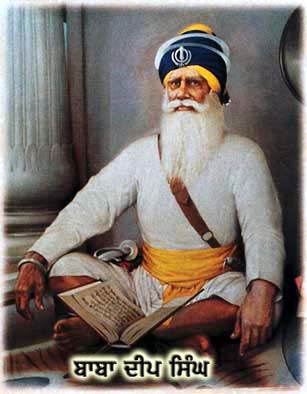
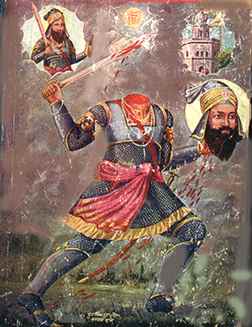
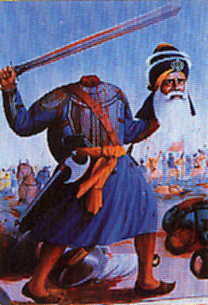
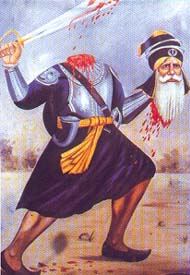
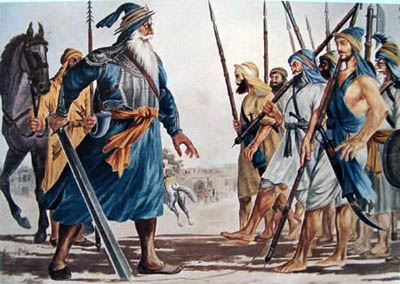 As soon as Baba Ji had finished all the Singhs began to run across the line. Baba Ji then led the sangat in an ardas to Guru Sahib. The Singhs asked Maharaj to bless this marriage of theirs and to prepare for them as they readied themselves to return to his kingdom. During this ardas Baba Ji made a vow that no matter how much blood he would spill, no matter how many times he would be cut, no matter how many arrows pierced his body, no matter how much pain he had to endure, he would not become shaheed until SachKhand Sri Darbar Sahib was liberated and its sanctity restored.
 Waheguru Ji Ka Khalsa Waheguru Ji Ki Fateh
